

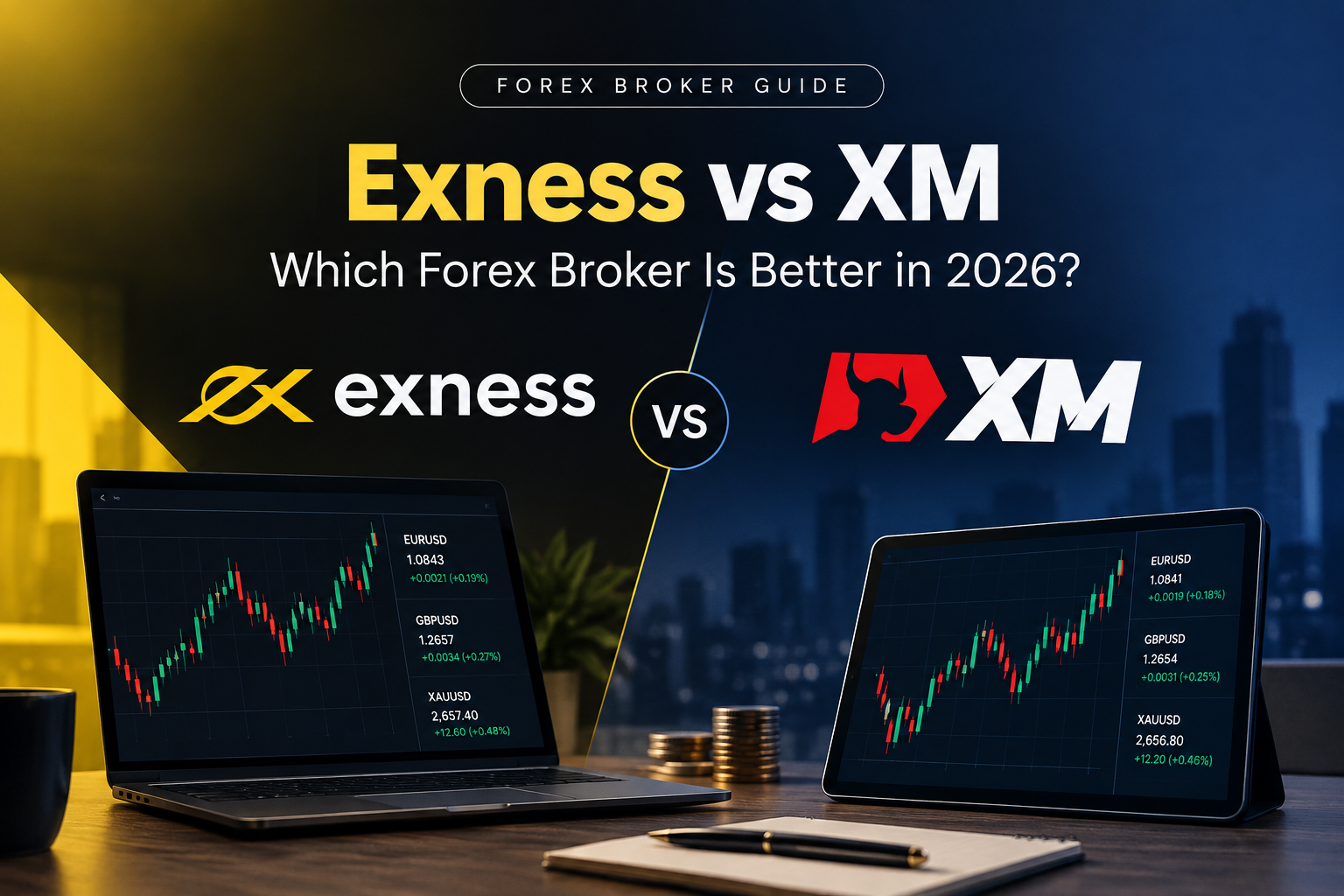
Four of the top-ranking Exness vs XM comparisons quote four different EUR/USD spreads for XM, ranging from 0.1 to 2.0 pips. They can’t all be right, and most never tell you which XM entity or account they tested.
That matters because Exness and XM are both large, multi-entity brokers. The company that actually holds your money depends on where you live, and so do your leverage, your bonus eligibility, and your investor protection. Both brokers also exclude US residents, and both appear on the Reserve Bank of India’s Alert List.
This guide compares the two brokers on regulation by entity, real per-lot costs, leverage, withdrawals and regional access, using each broker’s own pages and named, dated reviews.
How Do Exness and XM Compare at a Glance in 2026?
Exness suits cost-focused forex and gold traders who want tight Standard-account spreads, very high leverage, and automated withdrawals. XM suits traders who want 1,400+ instruments, a regulated EU option and deposit bonuses outside Europe. Neither broker accepts US residents, and both carry RBI Alert List exposure for Indian traders.
| Feature | Exness | XM |
| Main global entity | Exness (SC) Ltd, FSA Seychelles (SD025) | XM Global Limited, FSC Belize (8557558) |
| EU / UK retail clients | Not accepted (CySEC and FCA entities serve professionals only) | Accepted in the EU via CySEC entity (120/10) |
| Minimum deposit | $10 Standard; $200 Pro, Zero, Raw Spread | $5 Standard and Ultra Low; $10,000 Shares |
| Max leverage (global entities) | 1:2000, unlimited on qualifying accounts | Up to 1000:1 on forex and gold |
| Typical EUR/USD, standard account | 0.9 pips | 2.0 pips |
| Instruments | About 293 | 1,400+ |
| Platforms | MT4, MT5, Exness Terminal, Exness Trade app | MT4, MT5, XM App |
| Inactivity fee | None | $10 per month after 90 days |
| Automated withdrawals (self-reported) | Over 98% processed automatically | 92.9% automatically approved |
| Trustpilot (October 2026) | 4.7 from 32,611 reviews | No TrustScore shown; 3,122 reviews |
| US residents | Not accepted | Not accepted |
| RBI Alert List | Yes (#6) | Yes (#33) |
Entity data comes from the Exness regulation page and XM’s regulation page. Exness costs and instrument counts come from Dan Blystone’s FXEmpire Exness review (updated April 20, 2026). XM costs, leverage, and fees come from Louise Carr and Xevi Fontdeglòria’s FXStreet XM review (updated August 11, 2026).
Which Broker Is Safer: How Are Exness and XM Regulated?
Both brokers run through several regulated entities, but most retail clients outside Europe land with an offshore one: Exness (SC) Ltd in Seychelles or XM Global Limited in Belize. XM accepts EU retail traders through its CySEC entity with up to €20,000 investor compensation. Exness restricts its CySEC and FCA entities to professional clients.
The Exness Entity Structure
Per the Exness regulation page, the group operates these entities:
| Entity | Regulator | License | Who it serves |
| Exness (SC) Ltd | FSA Seychelles | SD025 | Non-EEA clients |
| Exness B.V. | CBCS (Curaçao and Sint Maarten) | 0003LSI | Non-EEA clients |
| Exness (VG) Ltd | FSC British Virgin Islands | SIBA/L/20/1133 | Non-EEA clients |
| Exness (MU) Ltd | FSC Mauritius | GB20025294 | Non-EEA clients |
| Exness ZA (PTY) Ltd | FSCA South Africa | 51024 | South African FSP license |
| Exness (Cy) Ltd | CySEC | 178/12 | Professional clients only |
| Exness (UK) Ltd | FCA | 730729 | Professional clients only |
Many comparisons list Exness as “FCA and CySEC regulated” without the qualifier. A retail trader in India, Southeast Asia or Africa won’t deal with either of those entities.
The XM Entity Structure
FXStreet’s August 2026 review lists seven XM entities, including Trading Point of Financial Instruments (CySEC 120/10), XM’s FSCA entity (FSP 49976), its DFSA entity (F003484) and XM Global Limited (FSC Belize, 8557558). The global xm.com site states in its footer that XM Global Limited, regulated by Belize’s FSC, operates it.
- EU clients trade with the CySEC entity at up to 30:1 leverage on major pairs, with investor compensation of up to €20,000
- Global clients trade with offshore entities at up to 1000:1 leverage, with deposit bonuses and no EU-style compensation scheme
- All XM accounts include negative balance protection, according to XM’s account types page
Which Entity Will You Actually Get?
Your country decides, and your choice of broker doesn’t change that. Check the entity name on the client agreement before you deposit.
- Open the broker’s registration page for your country
- Find the legal entity named in the client agreement or website footer
- Look up that entity’s license on the regulator’s own register
- Confirm whether that regulator runs a compensation scheme
Which Broker Has Lower Trading Costs: Exness or XM?
Exness is cheaper on standard accounts. FXEmpire measured a typical 0.9-pip EUR/USD spread on Exness Standard, while FXStreet recorded 2.0 pips on XM Standard. On commission accounts the gap narrows: both brokers charge about $7 per round-turn lot on their raw-spread products, plus a near-zero spread.
Why Every Comparison Quotes a Different XM Spread
| Source | XM EUR/USD spread quoted | What it likely measured |
| DailyForex | 0.1 pips | Raw or Zero-type pricing |
| ForexBrokers.com (Feb 2025) | 1.1 pips average | Standard account, older data |
| BrokerAnalysis (Aug 2026) | 1.6 pips | Standard account |
| FXStreet (Aug 2026) | 2.0 pips | Standard and Micro accounts |
The spread changes with the account type, the entity, the session, and the date of the test. A comparison that doesn’t name all four isn’t telling you much. XM’s own homepage advertises spreads “as low as 0.8 pips.” That figure describes best-case pricing, and FXStreet’s typical Standard-account reading sits at 2.0 pips.
All-In Cost Per Standard Lot on EUR/USD
Each pip on one standard lot of EUR/USD is worth $10. Using the reviewers’ typical spreads and published commissions:
| Account | Typical spread | Commission per lot | All-in cost per round turn |
| Exness Standard | 0.9 pips | None | $9.00 |
| Exness Raw Spread | From 0.0 pips | Up to $7.00 | From $7.00 |
| XM Standard | 2.0 pips | None | $20.00 |
| XM Ultra Low | 1.6 pips | None | $16.00 |
| XM Zero (entity-dependent) | 0.0 to 0.3 pips | $7.00 | $7.00 to $10.00 |
A trader running 20 standard lots a month on XM Standard pays about $220 more than on Exness Standard at these spreads. On commission accounts, the two brokers sit within a few dollars of each other.
Non-Trading Fees
- Exness charges no deposit, withdrawal, or inactivity fees, according to FXEmpire
- XM charges no deposit or withdrawal fees on cards, e-wallets, or bank transfers, per FXStreet
- XM charges a $10 monthly inactivity fee after 90 days without activity, per FXStreet
Weighing XM’s Product Range Against Its Costs?
XM’s 1,400+ instruments and EU-regulated entity suit some traders better than a cheaper spread. Our XM review covers its accounts, bonus terms, and withdrawal record in detail.
Read our full XM broker review
How Do Leverage, Account Types and Minimum Deposits Differ?
Exness offers up to 1:2000 leverage by default on its global entities, and unlimited leverage on qualifying small accounts. XM caps global leverage at 1000:1 on forex and gold. XM opens accounts from $5, while Exness starts at $10 on Standard and $200 on its professional-style accounts.
| Account | Minimum deposit | Pricing model |
| Exness Standard | $10 | Spread only |
| Exness Standard Cent | $10 | Spread only, cent lots |
| Exness Pro | $200 | Professional account |
| Exness Zero | $200 | Professional account, commission-based |
| Exness Raw Spread | $200 | Raw spread plus up to $3.50 commission per side |
| XM Standard | $5 | Spread only, bonus eligible |
| XM Ultra Low | $5 | Lower spread, no commission |
| XM Shares | $10,000 | Real shares, commission |
Exness account data comes from FXEmpire; XM’s minimums come from XM’s account types page.
How Exness Unlimited Leverage Works
FXEmpire reports that Exness switches on unlimited leverage only when both conditions hold:
- Account equity stays below $5,000
- The account has at least 10 closed orders and 5 or more standard lots of total volume
Unlimited leverage shrinks the margin you post, but it doesn’t change the size of your position or your loss per pip. A trader with $500 in equity can still lose the full balance on one oversized trade.
XM’s Bonus and Leverage Limits by Region
FXStreet reports that XM’s global entities offer deposit bonuses of up to 50% on first deposits, while EU rules restrict bonuses on the CySEC entity. EU leverage falls to 30:1 on major pairs, 20:1 on minors and gold, 10:1 on commodities and 5:1 on stocks. Read the bonus terms before you accept one, because bonus credit usually carries withdrawal conditions.
Which Broker Withdraws Faster and Offers Better Platforms?
Exness says it processes over 98% of withdrawals automatically, and FXEmpire lists e-wallet withdrawals as instant to one day. XM says 92.9% of its withdrawals get automatic approval. Both run MT4 and MT5, but XM offers roughly five times as many instruments, including real shares.
Withdrawals and Payout Experience
- Exness: over 98% of withdrawals processed automatically, per the Exness homepage; FXEmpire lists instant to one day for Skrill and Neteller
- XM: 92.9% of withdrawals automatically approved, per the XM homepage; FXStreet lists minutes for cards and 1 to 5 business days for bank wire
- Both brokers require completed account verification before a withdrawal goes through
Both automation figures are the brokers’ own claims, and no independent body audits them.
Platforms and Instruments
| Category | Exness | XM |
| MetaTrader 4 and 5 | Yes | Yes |
| Proprietary platform | Exness Terminal, Exness Trade app | XM App |
| Forex pairs | 123 | Included in 1,400+ total |
| Stock CFDs or shares | 101 stock CFDs | Stock CFDs plus real shares (Shares account) |
| Cryptocurrencies | 35 | Available on global entities |
| Total instruments | About 293 | 1,400+ |
What Trustpilot Shows Right Now
Exness on Trustpilot holds a 4.7 TrustScore from 32,611 reviews, with 89% at five stars. XM’s Trustpilot page currently shows no TrustScore, citing a breach of Trustpilot’s guidelines, and 57% of its 3,122 reviews are one-star. Recent one-star reviews describe withdrawal delays tied to routine checks. Several top-ranking comparisons still quote an XM rating that Trustpilot no longer displays.
Can Traders in India and the US Use Exness or XM?
Neither broker accepts US residents. In India, the Reserve Bank of India’s Alert List names Exness at number 6 and XM at number 33, both flagged as unauthorized under FEMA. Indian traders face the same regulatory question with either broker, so the choice between them doesn’t change that risk.
What the RBI Alert List Means for Indian Traders
The RBI’s Alert List names entities that FEMA doesn’t authorize to deal in forex and that the RBI hasn’t authorized to run forex electronic trading platforms. Exness and XM both appeared on the first list in September 2022, as Finance Magnates reported, and both remain on the November 2025 update of 95 names covered by Outlook Money.
- The RBI directs residents to its published lists of authorized persons and authorized electronic trading platforms to check any provider’s status
- The RBI states that residents who trade forex on unauthorized platforms are liable for penal action under FEMA, as Business Standard reported
- Speak to a chartered accountant or FEMA specialist before opening an account with either broker from India
Options for US Traders
The Exness regulation page lists the USA among the jurisdictions it doesn’t serve, and XM’s website states it doesn’t provide services to US citizens. US traders need a broker that accepts US clients, and our Liquid Brokers review covers one option.
Exness or XM: Which Broker Fits Your Trading Style?
Exness fits active forex and gold traders who care most about per-lot cost, high leverage, and fast automated withdrawals. XM fits traders who want stocks and indices alongside forex, an EU-regulated account, or a small $5 starting deposit. Your country of residence may settle the choice before cost does.
| Trader profile | Better fit | Reason |
| High-volume forex or gold scalper | Exness | $9 all-in on Standard versus $20 on XM Standard |
| EU retail trader | XM | Exness doesn’t accept EU retail clients |
| Multi-asset trader wanting real shares | XM | 1,400+ instruments and a Shares account |
| Trader starting with under $10 | XM | $5 minimum deposit |
| Trader who leaves accounts idle | Exness | No inactivity fee |
| Trader wanting the highest leverage | Exness | 1:2000 default, unlimited on qualifying accounts |
| US resident | Neither | Both exclude US residents |
| Indian resident | Take advice first | Both brokers appear on the RBI Alert List |
When Forex Advocate lined up the two brokers’ entity records, cost data, and review signals, Exness came out ahead on cost and withdrawal automation. XM’s lead rests on product breadth and its EU retail entity.
So, Should You Choose Exness or XM in 2026?
The broker name on the website matters less than the entity behind your account. For most traders outside Europe, both Exness and XM mean an offshore entity, high leverage, and no investor compensation scheme, so the comparison comes down to cost, product range, and how each firm treats withdrawals.
On those terms, Exness holds the stronger hand for forex and gold traders. Its Standard account costs less than half as much per lot as XM Standard, it charges no inactivity fee, and its Trustpilot profile shows a 4.7 score while XM’s currently shows none. XM earns its place if you want real shares, an EU-regulated account, or a $5 start.
Skip the entity check, and you could trade for years without knowing who holds your money or what protection you have. Five minutes with the client agreement fixes that.
See How Exness Holds Up in Our Full Review
Our Exness review covers its entity structure, account types, real spreads, leverage rules, and withdrawal record in one place. Read it before you open an account, so you know which Exness entity you’ll trade with and what that means for your money.
Frequently Asked Questions
Exness is the better fit for cost-focused forex and gold traders, with a typical 0.9-pip EUR/USD spread on its Standard account, no inactivity fee, and over 98% of withdrawals processed automatically. XM is the better fit for traders who want 1,400+ instruments, real shares, or an EU-regulated retail account. Most retail traders outside Europe will deal with an offshore entity at either broker, so check which entity serves your country before you compare anything else. Our all-forex brokers hub lists other options if neither fits.
Neither broker is clearly safer for most traders, because both serve non-EU retail clients through offshore entities: Exness mainly through FSA Seychelles and XM through FSC Belize. XM offers stronger protection for EU residents, who trade with its CySEC entity and get up to €20,000 investor compensation. Exness restricts its CySEC and FCA entities to professional clients. Both brokers offer negative balance protection. Trustpilot currently shows Exness at 4.7 and displays no TrustScore for XM, citing a guidelines breach.
Exness has lower spreads on standard accounts. FXEmpire measured a typical 0.9-pip EUR/USD spread on Exness Standard, and FXStreet recorded 2.0 pips on XM Standard, which works out to about $9 versus $20 per round-turn lot. On commission-based accounts, the gap shrinks to a few dollars, with both brokers charging about $7 per lot plus a near-zero spread. Spread figures vary by account, entity, and test date, so compare like-for-like accounts rather than headline "from" numbers.
Both Exness and XM appear on the Reserve Bank of India's Alert List, at numbers 6 and 33, which names entities not authorized under FEMA to deal in forex or run forex trading platforms. The RBI states that residents who trade forex on unauthorized platforms are liable for penal action under FEMA. Neither broker holds an RBI authorization for Indian residents. Speak to a chartered accountant or FEMA specialist before opening an account with either broker from India.
Neither Exness nor XM accepts US residents. Exness lists the USA among the jurisdictions it doesn't serve on its regulation page, and XM states that it doesn't provide services to US citizens, along with Canada, Israel, and Iran. US traders need a broker that accepts US clients under rules that apply to them. Check that a broker's US entity is registered with the CFTC and NFA, or confirm how it serves US clients, before you deposit.