


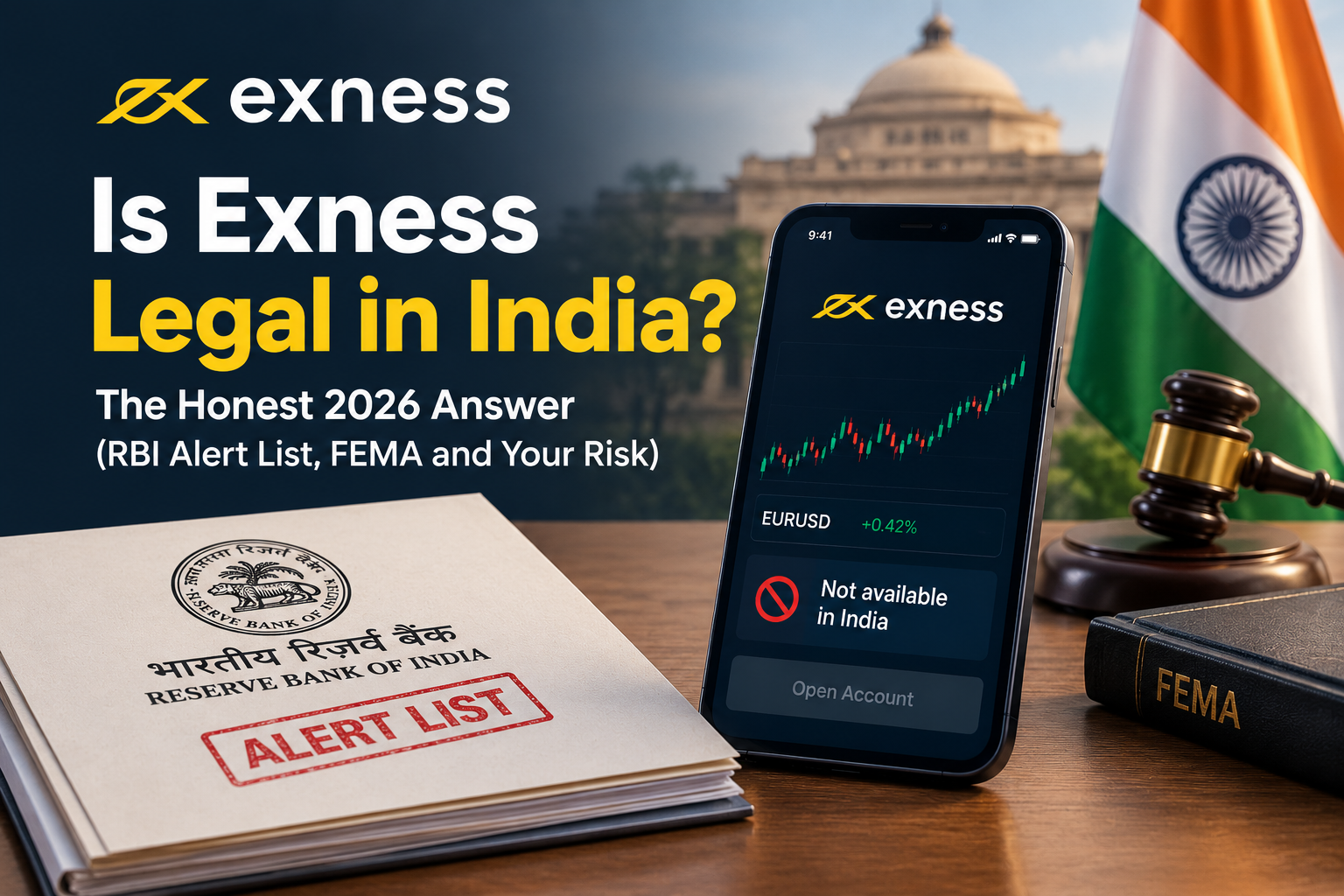
Exness has been on the Reserve Bank of India’s list of unauthorized forex platforms since that list first came out in September 2022, and it was still there in the November 2025 update. And yet the question “is Exness legal in India” keeps getting answers that run from a flat “yes” to “you’ll go to jail.”
Neither answer holds up. In July 2025, Exness quietly stopped taking new Indian sign-ups, and in March 2026 the Finance Ministry told Parliament that offshore forex platforms need RBI authorization before they can serve Indian residents. The rules are clearer than the internet makes them look.
This guide walks through what the RBI Alert List means, what FEMA actually allows, what enforcement has looked like so far, and the legal routes open to Indian traders.
Is Exness Legal in India in 2026?
No. Indian residents cannot legally trade forex through Exness. Exness has no RBI authorization to offer forex trading in India; it appears on the RBI’s Alert List, and RBI rules don’t allow residents to send money abroad for margin trading. Using Exness from India exposes you to penalties under the Foreign Exchange Management Act, 1999 (FEMA).
The Short Answer, Point by Point
| Question | Answer | Basis |
| Is Exness authorized in India? | No | Not an RBI-authorized ETP or SEBI-registered broker |
| Is Exness on the RBI Alert List? | Yes | Listed since September 2022; still listed in November 2025 |
| Can new Indian users open accounts? | No | Onboarding stopped on 11 July 2025 |
| Can residents legally fund an Exness account? | No | LRS bars remittances for overseas margin trading |
| Is any offshore forex broker legal for residents? | No | Finance Ministry answer in the Lok Sabha, March 2026 |
The clearest statement of government policy came on March 30, 2026. Answering Lok Sabha Unstarred Question No. 5817, as reproduced by TaxGuru, the Finance Ministry confirmed that offshore forex and CFD platforms without RBI authorization are not permitted under the current legal framework.
Why “Grey Area” Answers Mislead
You’ll still see the phrase “legal grey area.” Even Finance Magnates has written that India neither regulates nor bans CFDs, and that offshore brokers sit in a grey zone. That’s a fair description of the broker’s position. It just isn’t the trader’s position.
The RBI has been specific about individuals. In its own FAQ, quoted by Business Standard, the RBI says FEMA doesn’t allow residents to trade forex on unauthorized ETPs and that those who do face penal action. Some comparison sites still describe Exness as legal for Indians. That claim doesn’t match what the regulator itself says.
What Does the RBI Alert List Actually Mean for Exness?
The RBI Alert List names entities that are neither authorized to deal in forex under FEMA nor authorized to run electronic trading platforms (ETPs) for forex. It doesn’t mean that a broker is a scam. It confirms that the broker has no legal permission to serve Indian residents, whatever licenses it holds abroad.
How the List Has Grown Since 2022
| Date | Update | Exness status |
| September 2022 | First list, 34 entities | Listed |
| June 2023 | Expanded to 56 entries | Listed |
| November 2023 | 19 added, total 75 | Listed |
| October 2024 | 13 more platforms named | Listed |
| November 2025 | 7 added, total 95 | Listed |
Business Standard reported the first list of 34 entities in September 2022, and Entrepreneur India named Exness among them. Business Standard reported the June 2023 update, which brought the list to 56. Its November 2023 report covered 19 more additions, taking the total to 75. According to Outlook Money, the RBI added 7 more names on November 19, 2025, for a total of 95. The full list published by Upstox after that update still shows Exness.
What a Listing Means and Doesn’t Mean
- It means Exness has no authorization under FEMA or the RBI’s ETP rules to offer forex trading to Indian residents
- It means residents who trade there can’t rely on any Indian regulator for protection or grievance redress
- It doesn’t mean the RBI has judged Exness’s offshore licenses or its solvency
- It doesn’t make unlisted brokers safe. The RBI says the list isn’t exhaustive, and leaving a platform off it doesn’t mean the platform is authorized
That last point catches people out. A broker missing from the list is not a broker you’re cleared to use.
What Does FEMA Say About Trading on Exness From India?
FEMA lets Indian residents deal in foreign exchange only with authorized persons, and only for permitted purposes. For currency trading, the permitted route is exchange-traded currency derivatives on recognized Indian stock exchanges. Leveraged trading on an offshore platform like Exness falls outside every permitted category.
What Residents Are Allowed to Do
The RBI has long said residents may trade currency futures and options listed on SEBI-recognized stock exchanges in India. An RBI circular sets out the permitted contracts:
- USD-INR, EUR-INR, GBP-INR and JPY-INR (rupee pairs)
- EUR-USD, GBP-USD and USD-JPY (cross-currency pairs, no rupee involved)
- Trading only on recognized Indian exchanges, through a SEBI-registered broker
What Residents Aren’t Allowed to Do
The Liberalised Remittance Scheme (LRS) lets you send up to USD 250,000 abroad each year, but it carries specific exclusions. The RBI’s LRS FAQ lists remittances for margins or margin calls to overseas exchanges or counterparties among the prohibited transactions.
- You can’t remit money abroad to fund overseas margin or forex trading
- You can’t trade forex on an ETP the RBI hasn’t authorized
- You can’t use other routes, such as cards, e-wallets or crypto, to get around these limits. The RBI’s warning, as reported by Business Standard, covers residents who remit or deposit funds “directly or indirectly” for unauthorized forex trading
The RBI also closed off a possible route in 2025. According to an IndusLaw analysis via Mondaq, the final 2025 ETP Master Direction dropped the offshore ETP provisions that the 2024 draft had proposed. That leaves offshore brokers with no codified way to become compliant.
The Penalty Framework Under Section 13
| Contravention type | Maximum penalty under FEMA Section 13(1) |
| Amount can be quantified | Up to three times the sum involved |
| Amount can’t be quantified | Up to ₹2 lakh |
| Contravention continues | Additional ₹5,000 for every day after the first |
A presentation published by ICAI’s Western India Regional Council confirms these figures are ceilings, set by an adjudicating authority. They aren’t automatic fines. In practice, though, “three times the sum involved” applied to years of deposits can add up to a serious liability.
Has Anyone in India Been Penalized for Using Offshore Forex Platforms?
Public enforcement so far has targeted platforms, their Indian agents and the payment networks behind them, rather than individual traders. Our research at Forex Advocate found no public record of authorities prosecuting an individual Exness client. The legal exposure still exists, and the practical risks reach traders well before any prosecution would.
The OctaFX Case: What Enforcement Looks Like
OctaFX shows how far Indian authorities will go against an unauthorized forex platform.
| Date | Action |
| September 2022 | ED freezes about ₹21.14 crore of OctaFX India’s balances |
| July 2025 | ED attaches a yacht and Spanish properties worth about ₹131 crore |
| October 2025 | ED attaches crypto worth about ₹2,385 crore; total attached passes ₹2,681 crore |
The Statesman reported the ED’s first freeze of about ₹21.14 crore under FEMA. In a July 2025 press release, the ED said it had attached a luxury yacht and Spanish properties worth about ₹131.45 crore, and had filed two prosecution complaints naming OctaFX and 54 others. Its October 2025 press release put total attachments in the case at more than ₹2,681 crore.
What This Means for Individual Traders
The ED’s FY 2024-25 annual report notes that FEMA treats most violations as civil offences, not criminal ones. That’s a real distinction. But a civil penalty is still a penalty, and the practical risks show up much sooner:
- Payment disruption. Unauthorized platforms often move money through intermediary accounts that authorities can freeze
- Bank scrutiny. Unusual payments linked to offshore trading can trigger questions from your bank
- No recourse. If a withdrawal stalls, no Indian regulator will step in for you
Want the full picture on Exness beyond India?
Our Exness review covers its global regulation, account types, trading conditions, and withdrawal record for traders in countries where it can legally operate.
Read our full Exness broker review
What Happened to Exness in India in July 2025?
Exness stopped onboarding new Indian customers on 11 July 2025 and never publicly explained why. Existing Indian clients could keep trading, but Exness began moving them from its Seychelles entity to a unit registered in Vanuatu. Reports since then suggest Exness has no plans to reopen Indian sign-ups.
What Changed for Indian Clients
According to Finance Magnates, the broker paused Indian registrations on 11 July 2025, kept serving existing clients, and offered no explanation. The same report described three developments:
- No new sign-ups. India-based registrations stopped on 11 July 2025
- Entity migration. Existing Indian clients moved from the Seychelles entity to a Vanuatu-registered unit, again without explanation
- Banking hiccups. Some users reported the bank deposit and withdrawal option suddenly disappearing, though an Exness affiliate later showed bank transfers working again
Is Exness Coming Back?
Influencers have speculated about a return under a different brand. BrokerListings, however, says it contacted Exness support in September 2026 and was told there are no plans to resume Indian sign-ups. And even if Exness did come back, its legal status wouldn’t change unless it obtained RBI authorization.
What Should Indian Exness Clients Do Now?
If you already have an Exness account, the safest course is to stop depositing new money, withdraw your balance to your own verified account, keep full records, and talk to a chartered accountant or a FEMA specialist. Waiting doesn’t reduce your exposure. Under Section 13, continuing contraventions can attract daily penalties.
A Practical Exit Sequence
- Stop new deposits now. Every new remittance is a fresh transaction under FEMA.
- Check which entity holds your account. Your Personal Area shows whether you’ve been moved to the Vanuatu-registered unit.
- Withdraw to your own account. Use a verified account in your own name, and avoid third-party agents.
- Download your full statements. Keep deposit records, withdrawal confirmations and trade history.
- Get professional advice. A qualified chartered accountant or FEMA lawyer can tell you whether compounding, a FEMA procedure for settling contraventions, makes sense in your case, and how to report any gains for tax.
Red Flags After You Exit
- Agents offering “safe” payment routes through someone else’s UPI or bank account
- Promises that a new brand name makes the same service legal
- Anyone asking for fees to “recover” or “unfreeze” offshore funds
How Can Indians Trade Forex Legally in 2026?
Indian residents can legally trade currency futures and options on NSE, BSE and MSE through a SEBI-registered broker. The permitted contracts are four rupee pairs (USD-INR, EUR-INR, GBP-INR, JPY-INR) and three cross-currency pairs (EUR-USD, GBP-USD, USD-JPY). This route gives you regulatory protection that no offshore broker can offer.
Exness vs the Legal Exchange Route
| Feature | Exness (from India) | Indian exchange currency derivatives |
| Legal status for residents | Not permitted | Permitted under RBI and SEBI rules |
| Indian regulator | None | SEBI, RBI and the exchange |
| Major pairs available | Many | EUR-USD, GBP-USD, USD-JPY plus rupee pairs |
| Funding route | Offshore remittance (barred under LRS) | Domestic INR transfers |
| Grievance redress | Offshore regulator only | SEBI and exchange mechanisms |
| Product type | OTC CFDs | Exchange-traded futures and options |
Getting Started on the Legal Route
- Pick a SEBI-registered broker that offers the currency derivatives segment.
- Complete KYC and activate the currency segment.
- Start with the more liquid USD-INR contracts before moving to cross pairs.
- Learn how exchange margin works, since it differs from offshore leverage settings.
You give up the extreme leverage offshore brokers advertise. In return, you get legal certainty, a regulated counterparty, and money that moves through ordinary domestic banking.
Conclusion
What matters most is that Exness’s legal status in India rests on where your money goes, not on which app you open. The moment rupees leave India to fund leveraged forex trading on an unauthorized platform, you’ve stepped outside what FEMA permits. A broker’s foreign licenses can’t change that.
The upside is that the legal route is real and easy to reach. Since 2018, Indian exchanges have offered EUR-USD, GBP-USD, and USD-JPY contracts, the same major pairs most retail traders want, through brokers that answer to SEBI. You can trade the same currency moves without remittance problems, frozen payments, or unanswered withdrawal tickets.
Staying with an unauthorized platform carries risks that grow over time: possible penalties of up to three times the amount involved, payment channels that can disappear overnight, and no Indian regulator to turn to. The smarter move is to compare brokers with their regulatory status in plain view.
Compare brokers by what actually protects you
Our broker hub sets out regulation, licensing jurisdictions, and trading conditions side by side, so you can see who answers to which regulator before you deposit anything. If you trade from India, start with regulatory status and work backward from there.
Frequently Asked Questions
India hasn’t issued a formal “ban” order naming Exness, but Exness has no authorization to offer forex trading to Indian residents and has been on the RBI’s Alert List since September 2022. The practical effect is the same: residents can’t legally trade forex there. Exness also stopped accepting new Indian registrations on 11 July 2025. The Finance Ministry told the Lok Sabha in March 2026 that offshore forex and CFD platforms without RBI authorization are not permitted. So “not banned by name” shouldn’t be read as “allowed.”
Existing Indian clients have generally been able to keep using their accounts and withdraw funds since Exness paused new Indian sign-ups in July 2025. Some users did report the bank transfer option disappearing for a while. Withdraw to a verified account in your own name, and never use third-party agents or someone else’s UPI handle. Keep complete records of every deposit and withdrawal. A chartered accountant can advise on reporting and on whether FEMA compounding applies to you. Our Exness review covers Exness’s withdrawal methods in more detail.
Trading on Exness from India breaks FEMA, but FEMA mostly treats contraventions as civil matters with monetary penalties, not criminal offences. Section 13 allows penalties of up to three times the sum involved, plus ₹5,000 a day for continuing contraventions. Criminal cases, such as the PMLA action against OctaFX, have so far targeted platforms, their agents and payment networks. That still leaves individual traders exposed to adjudication, payment freezes, and the loss of any Indian regulatory protection. A FEMA specialist can assess your own position.
Yes, Exness is on the RBI Alert List. It was among the 34 entities named when the RBI first published the list in September 2022, and it was still listed after the November 2025 update, which brought the total to 95. A listing means Exness isn’t authorized under FEMA to deal in forex or run a forex trading platform for Indian residents. It isn’t a fraud finding. The RBI says the list isn’t exhaustive, so absence from it never means a platform is authorized.
Forex trading is legal in India only through exchange-traded currency derivatives on recognized Indian exchanges, accessed through a SEBI-registered broker. Residents can trade futures and options in four rupee pairs (USD-INR, EUR-INR, GBP-INR, JPY-INR) and three cross-currency pairs (EUR-USD, GBP-USD, USD-JPY). Offshore leveraged forex and CFD trading isn’t permitted, and the Liberalised Remittance Scheme bars sending money abroad for margin trading. These rules can change, so check the latest RBI and SEBI guidance before you trade.

)
&description=&image=https://forexadvocate.com/wp-content/uploads/2026/10/Exness-Legal-in-India_-1024x683.png)