

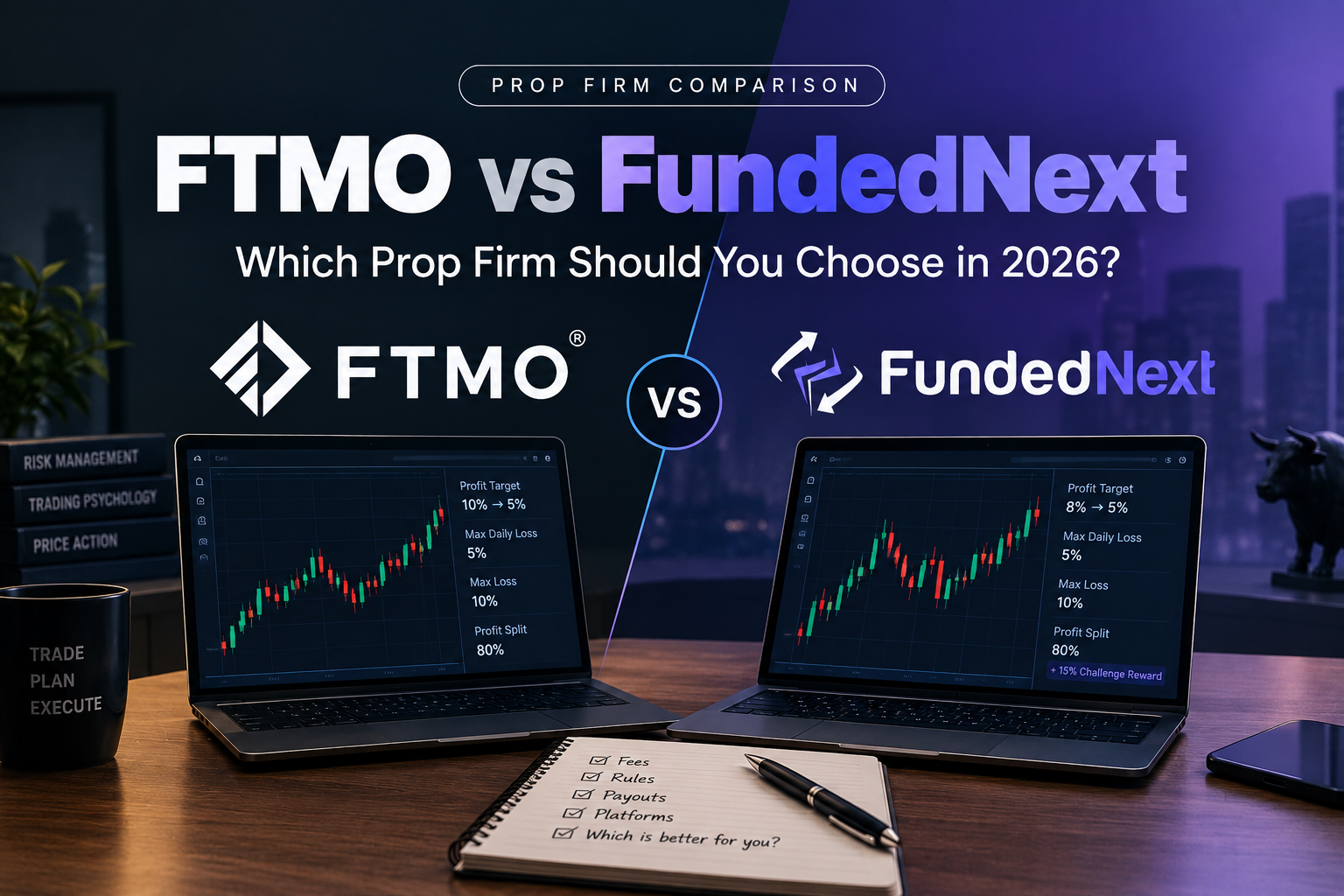
On a $100K two-step account, FundedNext asks for less profit to pass than FTMO does. FTMO’s published rules still open your first reward claim a full week earlier.
That’s the pattern across the whole FTMO vs FundedNext comparison. The headline numbers favor one firm, and the fine print often favors the other. FTMO reports more than $650M paid in rewards since 2015, and FundedNext reports more than $306.9M. Both sit above 4.5 on Trustpilot with more than 50,000 reviews each, so neither one is a fringe operator.
This guide compares the verified 2026 fees, challenge rules, funded-account restrictions, payout timing, and regional access for both firms. By the end, you’ll know which one fits the way you actually trade.
How Do FTMO and FundedNext Compare at a Glance in 2026?
FTMO is the Prague-based original with a shorter rulebook, a 4.8 Trustpilot score, and a fully refundable 2-Step fee. FundedNext sells four CFD challenge models, a lower 8% Phase 1 target, a 15% challenge-phase reward, and an optional 95% reward share. Both start funded traders on an 80% split.
| Feature | FTMO 2-Step | FundedNext Stellar 2-Step |
| Operating entity | FTMO, Prague, Czech Republic | FundedNext Ltd (Comoros); brand owned by GrowthNext F.Z.E., Ajman, UAE |
| $100K challenge fee | €540 (about $611) | $549.99 |
| Cheapest 2-Step entry | €89 ($10K) | 59.99(6K) |
| Profit targets | 10% then 5% | 8% then 5% |
| Max daily loss | 5% | 5% |
| Max loss | 10% static | 10% static |
| Minimum trading days | 4 per phase | 5 |
| Time limit | Unlimited | None |
| Default reward share | 80% | 80% |
| Maximum reward share | 90% via Scaling Plan | 95% via paid add-on |
| Fee refund | 100% with first reward | With first reward |
| First reward claim | Day 14 after first funded trade | Day 21, then every 14 days |
| Challenge-phase reward | None | 15% of challenge profit |
| Platforms | MT4, MT5, cTrader | MT4, MT5, cTrader, Match-Trader |
| Trustpilot | 4.8 (53,448 reviews) | 4.5 (80,601 reviews) |
| Self-reported rewards paid | $650M+ | $306.9M+ |
Rule data comes from FTMO’s Trading Objectives page and 2-Step Challenge page, and from FundedNext’s CFD challenge page. Review counts come from Trustpilot’s pages for FTMO and FundedNext, checked in October 2026. Payout totals are each firm’s own figures, and no independent body audits them.
Which Challenge Is Easier to Pass: FTMO 2-Step or FundedNext Stellar 2-Step?
FundedNext’s Stellar 2-Step is easier on paper. Its Phase 1 target is 8% against FTMO’s 10%, while the Phase 2 target, daily loss, and maximum loss match. On a $100K account, you need $13,000 of total profit at FundedNext versus $15,000 at FTMO, with one extra minimum trading day.
The Profit Target Gap in Real Terms
A 2% lower Phase 1 target is worth $2,000 on a $100K account. If you risk 1% per trade and aim for 2R winners, that’s one fewer winning trade before you reach Verification. It sounds small. Over several attempts, it adds up.
The drawdown limits leave no edge either way. Both firms set a 5% daily loss limit and a 10% static maximum loss on the 2-Step product, so your survival buffer is identical.
How FTMO Calculates Its Daily Loss Floor
FTMO publishes its formula in full. Each day at 00:00 CET (S)T, FTMO takes your account balance and subtracts 5% of the starting capital. Your equity, including open profit and loss, swaps, and commissions, can’t drop below that floor during the day.
- Day 1 on a $100K account: the floor sits at $95,000
- Close Day 1 at $102,000: Day 2’s floor rises to $97,000
- Floating losses count immediately, so an open trade can breach you before you close it
Banked profit raises tomorrow’s floor. Traders who press after a strong day often forget this.
Where FundedNext’s Challenge Adds Value
FundedNext pays a 15% performance reward on profit earned during the challenge. Its plan card lists $117 for a $6K account, which equals 15% of the combined 13% target. Apply the same math to $100K, and the reward comes to $1,950. Third-party rulebooks describe different payment conditions for this reward, so confirm the current trigger in FundedNext’s Help Centre before you count on it.
What Does Each Challenge Really Cost Once You Count Refunds and Rewards?
At list price, a $100K FTMO 2-Step costs €540, and FundedNext’s $100K Stellar 2-Step costs $549.99. Both firms return the fee with your first reward. The real gap appears after you pass: FundedNext’s 15% challenge-phase reward can add about $1,950 on a $100K account, and FTMO has no equivalent.
| Cost line ($100K, 2-Step) | FTMO | FundedNext |
| List fee | €540 (about $611) | $549.99 |
| Fee if you fail | Lost | Lost |
| Fee refund after passing | 100% with first reward | With first reward |
| Challenge-phase reward at exact targets | $0 | $1,950 |
| Net position after first reward | Fee recovered | Fee recovered plus up to $1,950 |
The Currency Line Most Comparisons Skip
FTMO prices its challenges in euros. Using the Reserve Bank of India’s reference rates for October 1, 2026 (₹108.6151 per euro and ₹95.9927 per dollar), €540 works out to roughly $611. Measured in dollars, FundedNext’s $100K fee runs about 10% cheaper. Your card issuer will add its own conversion spread on top, which is one of the costs we cover in our guide to hidden fees in forex prop firms.
Promotions Move the Numbers Every Week
Both firms discount aggressively. During our check, FTMO’s homepage advertised 20% off its $100K 1-Step Challenge, and FundedNext showed a 41% discount code on its $6K Stellar 2-Step. Compare list price against list price, then treat any promotion as a bonus.
See How FundedNext Holds Up Beyond the Price Tag
A cheaper fee only matters if the payouts arrive and the rules stay stable. Our review tests FundedNext’s Stellar models, payout record, and support against the criteria we use for every firm.
Read our full FundedNext review
Which Funded-Account Rules Cost Traders the Most at FTMO and FundedNext?
The rules that switch on after you’re funded differ more than the challenge rules do. FTMO restricts news trading and overnight or weekend holding on Standard funded accounts only. FundedNext caps your total open risk at 3% of the initial balance and credits only 40% of profit from news-window trades.
FTMO: Standard Accounts vs Swing Accounts
FTMO splits its 2-Step product into two account types. The difference only matters once you’re funded, and FTMO’s FAQ on news trading and overnight and weekend positions spells it out:
- Standard funded accounts carry restrictions around selected news releases and on holding positions overnight or over the weekend
- Swing funded accounts carry neither restriction
- Neither restriction applies during the evaluation, whichever type you pick
- The 1-Step Challenge doesn’t offer a Swing version
Pick the account type before you place your first trade. FTMO only allows platform and account-type changes on an untouched account or after a reward withdrawal. We break down the rest of FTMO’s fine print in FTMO 2026 Rules Decoded.
FundedNext: The 3% Risk Cap and the 40% News Rule
FundedNext’s funded rules on its CFD page add two limits that FTMO doesn’t have:
- Max Risk: 3% at any time. Your combined open risk across all positions can’t exceed 3% of the starting balance. Two trades risking 1.6% each already breach it.
- News Trading Profit: 40%. Profit from trades around high-impact news counts at 40% toward your reward.
- Consistency: N/A. The Stellar 2-Step funded account carries no consistency rule.
The 3% cap hits portfolio traders hardest. If you run several correlated positions at once, size them against the combined limit rather than trade by trade.
| Funded rule | FTMO 2-Step Standard | FTMO 2-Step Swing | FundedNext Stellar 2-Step |
| News trading | Restricted around selected releases | No restriction | Allowed; 40% of news profit counts |
| Overnight and weekend holding | Restricted | Allowed | Not listed on plan card; check terms |
| Combined open-risk cap | None published | None published | 3% of initial balance |
| Daily/max loss | 5% / 10% static | 5% / 10% static | 5% / 10% |
| Consistency rule | None on 2-Step | None on 2-Step | None |
Which Firm Pays Faster, and How Much Do You Keep?
FTMO opens your first reward claim on day 14 after your first funded trade. FundedNext’s Stellar 2-Step opens it after 21 days, then every 14 days. FundedNext processes faster once you ask, guaranteeing 24 hours or $1,000 extra. Both firms pay an 80% default share on their two-step products.
The Earliest Path to a First Reward
Here’s the fastest route each firm’s published rules allow, assuming you hit every target on the minimum days.
FTMO 2-Step, per its reward withdrawal FAQ:
- Pass Phase 1 in a minimum of 4 trading days
- Pass Verification in a minimum of 4 trading days
- Complete identity verification and sign the FTMO Account agreement
- Claim your reward from day 14 after your first funded trade
- Wait 1-2 business days for review, then 1-2 business days for payment after invoice approval
FundedNext Stellar 2-Step, per its CFD page:
- Pass Phase 1 and Phase 2, with a 5-day trading minimum
- Complete KYC on the funded account
- Request your first reward after 21 days
- Receive it within 24 hours, or FundedNext pays $1,000 extra
FundedNext’s homepage reports a 40-hour average processing time. If speed to the first payout matters most, FundedNext’s Stellar 1-Step advertises a first reward within 7 days, which beats both two-step products.
How Much You Keep on $10,000 of Simulated Profit
| Scenario | Reward share | Your payout |
| FTMO 2-Step, default | 80% | $8,000 |
| FTMO 2-Step, after Scaling Plan | 90% | $9,000 |
| FundedNext Stellar 2-Step, default | 80% | $8,000 |
| FundedNext Stellar 2-Step, 95% add-on | 95% | $9,500, minus the add-on cost |
What FTMO’s Scaling Plan Requires
FTMO’s Scaling Plan moves 2-Step traders to a 90% split and adds 25% to the account balance every four months, up to $2M across all accounts. To qualify, you need:
- At least 4 months as an FTMO Trader since the start or last scale-up
- At least 10% net profit over those 4 months
- At least 2 processed rewards in the same period
- A positive balance at the time of scale-up
FundedNext sells its higher split up front. FTMO makes you earn it.
Are FTMO and FundedNext Safe and Legal for Traders in India and the US?
Both firms sell simulated evaluations and state that they aren’t brokers, so neither holds a forex license for this service. FTMO’s group now owns OANDA, a broker licensed in eight markets. For Indian residents, the RBI Alert List names both FTMO and FundedNext, a fact that outweighs any fee difference.
Corporate Structure and Track Record
- FTMO operates from Prague and has run its challenge since 2015. Its website states that FTMO companies “do not act as a broker and do not accept any deposits.”
- FTMO completed its acquisition of OANDA on December 1, 2025, according to Finance Magnates. OANDA holds licenses in eight markets and runs as a standalone business.
- FundedNext’s website footer lists FundedNext Ltd as registered in the Comoros Islands (registration HY01023052), with the trademark owned by GrowthNext F.Z.E. in Ajman, UAE. FundedNext also states it is “not a broker, dealer, exchange, or investment advisor.”
A prop firm reward is an unsecured claim on a private company. A longer operating history and a regulated parent group carry real weight when you’re deciding whose promise to trust.
What the RBI Alert List Means for Indian Traders
The Reserve Bank of India’s Alert List names entities that FEMA doesn’t authorize to deal in forex and that the RBI hasn’t authorized to run forex electronic trading platforms. FTMO appears at number 13 and FundedNext at number 83 in the November 19, 2025 update, which brought the list to 95 names, as Outlook Money reported.
The RBI states that residents who undertake forex transactions on unauthorized platforms are liable for penal action under FEMA, as Business Standard reported. The RBI hasn’t published guidance on simulated-evaluation fees specifically. Talk to a chartered accountant or FEMA specialist before you pay either firm from India.
Access for US Traders
- FTMO serves US residents through its FTMO/OANDA route on MetaTrader 5, according to Finance Magnates.
- FTMO Futures launched in beta in August 2026, alongside FTMO’s return to the US market, per Finance Magnates.
- FundedNext relaunched CFD challenges for US traders on Match-Trader, according to Finance Magnates’ FundedNext coverage. Platform eligibility for US residents has shifted during 2026, so check the checkout options before you buy.
FTMO or FundedNext: Which Prop Firm Fits Your Trading Style?
FTMO fits swing traders, news traders, and anyone running several positions at once, because its Swing account removes the main funded restrictions and it caps no combined risk. FundedNext fits budget-conscious traders who want a lower target, a challenge-phase reward, and the option to buy a 95% split from day one.
| Trader profile | Better fit | Reason |
| Swing trader holding over weekends | FTMO (Swing) | No overnight or weekend restriction once funded |
| News trader | FTMO (Swing) | No news restriction; FundedNext credits 40% of news profit |
| Multi-position portfolio trader | FTMO | No 3% combined open-risk cap |
| First-time challenger on a tight budget | FundedNext | Lower dollar fee and 8% Phase 1 target |
| Trader chasing the highest split now | FundedNext | 95% add-on with no four-month wait |
| Trader wanting the earliest first payout | FundedNext (1-Step) or FTMO (2-Step) | 7-day first reward on Stellar 1-Step; day 14 on FTMO 2-Step |
| Indian resident | Take advice first | Both firms appear on the RBI Alert List |
When Forex Advocate compared the two rulebooks line by line, the fee rarely decided the match-up. What decided it was whether a trader’s normal habits, such as holding through Friday, trading CPI releases, or stacking correlated positions, survive the funded-account rulebook.
So, Should You Choose FTMO or FundedNext in 2026?
The cheaper challenge won’t always be the cheaper prop firm. FundedNext wins the entry price, the Phase 1 target, and the 15% challenge-phase reward, yet its 3% combined risk cap and 40% news credit quietly reshape how you can trade once funded. FTMO charges more and caps its split at 90%, and in return it hands you a shorter rulebook, a Swing account that removes the main funded restrictions, and an earlier first claim on its 2-Step product.
That makes the choice simpler than most comparisons suggest. Match the firm to your habits and ignore the banner discount. Traders who skip this step tend to pass the challenge and then lose the funded account to a rule they never read, which turns a refundable fee into a sunk cost.
If FTMO’s structure fits how you trade, the next step is to check whether its payout record, support, and current rules hold up under scrutiny.
Check FTMO Before You Buy the Challenge
Our FTMO review breaks down the 2026 rules, payout experience, Scaling Plan, and the trader complaints that matter most. Read it before you pick between Standard and Swing, because once you trade, FTMO only lets you switch after a reward withdrawal.
Frequently Asked Questions
FTMO suits traders who want a shorter rulebook, a Swing account free of news and weekend restrictions, and a 2-Step first reward claim from day 14. FundedNext suits traders who want a lower $100K fee in dollar terms, an 8% Phase 1 target, and a 15% challenge-phase reward. Neither firm is better for everyone. If you hold trades over weekends or trade high-impact news, FTMO's Swing account removes the rules most likely to cost you. If you trade one position at a time and want the highest possible split, FundedNext's 95% add-on gets you there without FTMO's four-month Scaling Plan wait.
FundedNext is cheaper at list price on most sizes. Its $100K Stellar 2-Step costs $549.99, while FTMO's $100K 2-Step costs €540, roughly $611 at RBI reference rates for October 1, 2026. Both firms refund the fee with your first reward, so the fee only stays a cost if you fail. FundedNext also pays a 15% reward on challenge profits, worth about $1,950 on a $100K account at exact targets. Promotions change these numbers weekly, so compare list prices first. Our guide to hidden fees in forex prop firms covers the currency and add-on costs that sit outside the sticker price.
FundedNext processes payouts faster, but FTMO's 2-Step opens the first claim sooner. FTMO allows a first reward claim from day 14 after your first funded trade, with review and payment taking up to about four business days. FundedNext's Stellar 2-Step opens the first withdrawal after 21 days and guarantees processing within 24 hours or $1,000 extra. After the first payout, FundedNext's 14-day cycle and fast processing give it the edge. Traders who want the quickest first reward of all should look at FundedNext's Stellar 1-Step, which advertises a first reward within 7 days.
FundedNext offers the higher maximum split at 95%, available through a paid add-on at checkout. FTMO's 2-Step tops out at 90%, which you unlock through its Scaling Plan after four months, 10% net profit, and two processed rewards. Both firms start funded 2-Step traders at 80%. On $10,000 of simulated profit, that's $9,500 at 95% versus $9,000 at 90%, before you subtract the cost of FundedNext's add-on. FTMO's 1-Step Challenge pays 90% from the start, though FTMO doesn't advertise its fee as refundable.
Both FTMO and FundedNext appear on the Reserve Bank of India's Alert List, at numbers 13 and 83 in the November 19, 2025 update. The list names entities that FEMA doesn't authorize to deal in forex and that the RBI hasn't authorized to run forex trading platforms. Both firms say they provide simulated evaluations and aren't brokers, and the RBI hasn't issued guidance on evaluation fees specifically. Because the RBI warns that residents using unauthorized platforms risk penal action under FEMA, speak to a chartered accountant or FEMA specialist before paying either firm from India.