

Most traders focus on the challenge fee. That’s the number prop firms put front and center, the one in the ad and on the pricing page. What they don’t show you are the activation fees, spread markups, reset charges, platform subscriptions, and withdrawal conditions that can quietly eat through your capital before you ever see a payout. This guide breaks every one of them down.
What Are the Real Costs of a Forex Prop Firm Challenge?
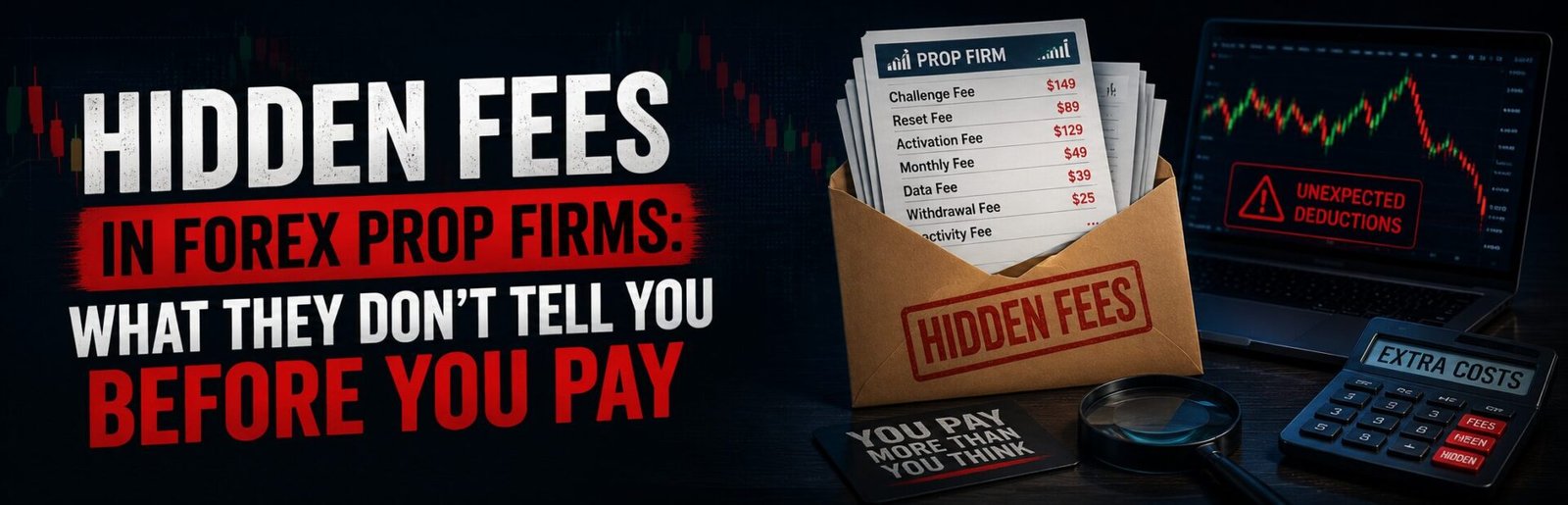
The real cost of a prop firm challenge is almost always higher than the headline price. The challenge fee is only one part of the total spend. Depending on the firm, you can also face activation fees when you pass, reset fees if you fail, monthly platform charges, inflated spreads on every trade, and withdrawal fees when you finally try to get paid.
A 2025 case study published by Damn Prop Firms illustrated this clearly: a trader who bought into a “$40 account” during a flash sale ended up spending $480 before placing a single live trade. That total included the initial $40, three resets at $100 each, and a $140 activation fee. The firm collected that money regardless of whether the trader ever got funded. (Damn Prop Firms).
What Is an Activation Fee and Why Do Some Firms Charge It?
An activation fee is a charge some prop firms collect after you pass the challenge, before they give you access to the funded account. In effect, you pay twice for the same opportunity. You paid the challenge fee to earn the right to trade a funded account, and then you pay again to activate it.
Activation fees typically run between $100 and $200. For lower-priced challenges marketed as “$50 accounts” or similar, the activation fee can equal or exceed the original challenge cost. Firms frame this as an administrative or account setup charge, but there is no industry-standard justification for it. (AquaFunded)
The firms with the strongest reputations, including FTMO, tend not to use activation fees. FTMO posted $329 million in revenue in 2024 with $62.5 million in net profit, built on a model that prioritizes transparent pricing and consistent payouts rather than layered charges. (CoinCodeCap)
How Much Do Reset Fees Actually Cost Traders?
Reset fees are charged when you breach a rule and want to restart a challenge without paying the full challenge fee again. They sound reasonable in isolation. In practice, they are one of the primary revenue sources for firms whose business model depends on traders failing repeatedly.
Reset fees typically range from $50 to $150 per reset. When a firm’s marketing focuses heavily on offering resets, that is a signal worth examining. If the economics worked in traders’ favor, firms would not be so eager to offer another reset. (Damm Prop Firms)
As For Traders noted in their 2026 analysis of funded trading costs, when a firm’s primary revenue depends on reset fees rather than a share of simulated performance rewards, the incentive structure does not favor the trader.
Set a hard spending cap before you start: two resets maximum or a fixed total budget, and stick to it. If you keep hitting the same failure point, more attempts will not solve a strategy problem.
Are Monthly Platform Fees a Hidden Cost of Prop Firm Trading?
Yes. Some prop firms charge monthly platform or maintenance fees that are disclosed in the terms of service but not mentioned in their marketing. These can be as low as $15 per month or as high as $39 per month or more. They are deducted from your funded account balance, which also reduces your drawdown buffer.
Twelve months of a $39 monthly fee totals $468, roughly three times the cost of a typical one-time activation fee. (AquaFunded)
Futures-focused firms tend to carry the most exposure here. CME data feed subscriptions run $30 to $130 per month depending on the exchange bundle. Platform licensing for NinjaTrader, Rithmic, or Tradovate adds another $10 to $99 per month. The total recurring cost on a futures prop account can reach $50 to $250 per month before a single trade is placed. (For Traders)
Forex prop firms generally avoid monthly charges, but not universally. Always check the full pricing page and the terms of service, not just the challenge price.
How Do Spread Markups Add to Your Trading Costs?
Prop firms mark up the spreads they pass to traders. You are not trading at raw interbank rates. The firm quotes you a wider spread and keeps the difference as revenue on every single trade you place.
On forex major pairs, prop firms typically add 0.2 to 0.8 pips above what a retail ECN broker would charge. On exotic pairs, that markup rises to 1.5 to 3.0 pips. On indices, firms add $0.20 to $0.50 per point compared to a retail ECN. (JPTradingCapital)
On XAUUSD (gold), raw spread runs roughly 0.10 to 0.20 points at the interbank level. Retail prop platforms commonly quote 0.30 to 0.60 points on the same instrument. (For Traders) That gap costs a high-frequency trader real money across hundreds of positions per month.
For ECN-style accounts, commissions typically run $3 to $7 per round-turn lot on forex. The industry average is around $7 per round turn, with better-priced firms like DNA Funded charging $5. (CBS News) Tighter spread accounts often carry higher commissions. The number to evaluate is total cost per trade, not either figure in isolation.
What Withdrawal Fees Do Prop Firms Charge?
Withdrawal fees range from zero at trader-friendly firms to $30 per withdrawal at firms like TopStep. Some firms charge a percentage of the withdrawal amount, typically 1% to 3%, which compounds as account size grows.
Ten payouts from TopStep at $30 each equal $300 in processing fees, paid purely for the privilege of accessing money you already earned. (CoinCodeCap)
Beyond per-withdrawal charges, international bank transfer fees and currency conversion costs apply to traders outside the firm’s home currency. Some firms also enforce minimum withdrawal thresholds, only processing fee-free payments above $250 or similar amounts, which affects cash flow for traders who want to pull profits regularly.
Does the Advertised Profit Split Reflect What You Actually Take Home?
No. The advertised split is not the real take-home rate. According to Investopedia’s 2024 overview of prop trading compensation, the industry average true take-home rate, after splits, fees, and conditions, sits at 62% to 68% of gross trading profits for first-year funded traders. That is substantially lower than the 80% to 90% splits most firms advertise. (JPTradingCapital)
The gap comes from conditions tied to withdrawals that most traders overlook at signup:
FTMO starts at an 80/20 split and scales to 90/10 only after a cumulative withdrawal of $20,000.
The5ers applies a 50/50 split in the first “High Stakes” phase. That scales to 80/20 only after six months of profitable trading at a profit factor above 1.5, per their 2025 rule update.
E8 Funding holds back 20% of each withdrawal in reserve until three full payout cycles complete, which meaningfully affects cash flow for traders relying on trading income. (JPTradingCapital)
Consistency rules create another blocker. Firms with aggressive consistency requirements, such as minimum profitable-day counts or single-day profit caps, show failure rates 25% to 35% higher than firms using simple profit target and drawdown metrics. (AquaFunded) You can be in profit overall and still fail a payout request because one trading day generated too large a share of your total gains.
What Red Flags Should Traders Look for Before Paying Any Prop Firm?
Look for firms that require activation fees after a passed challenge, bury monthly platform fees in terms rather than the pricing page, apply consistency rules that are materially harder to meet than the headline challenge rules, or have changed payout terms for existing funded accounts mid-cycle.
That last point matters. Several firms that launched aggressively in 2023 and 2024 restructured their payout models while traders held funded accounts, leaving them with materially different terms than those they signed up under. A 2024 analysis by DipSway found that approximately 23% of new prop firms launched in that period failed to process payouts consistently beyond their first 90 days. (JPTradingCapital)
Before committing, verify these five things:
- Total cost to get funded, including challenge fee, activation fee, and any platform subscriptions
- Reset fee amount and how resets are structured
- Exact withdrawal conditions, including consistency rules and minimum trading day requirements
- True profit split at your account size, not the maximum advertised split
- Payout track record across independent review sources, not firm-produced content
Frequently Asked Questions
An activation fee is a charge collected after you pass a challenge, before you receive access to your funded account. You are effectively paying twice to trade the same opportunity. Some firms justify it as an account setup cost, but the most reputable firms in the industry do not charge one. It is a legitimate fee in the sense that it is disclosed in terms of service, but it is also one of the clearest signals that a firm prioritizes fee extraction over trader success. If you see an activation fee, factor it into the total cost of getting funded and compare that total against firms that do not charge one. Firms like FTMO have built dominant market positions without activation fees. Always read the pricing breakdown beyond the headline challenge cost.
Yes. Reset fees and new challenge purchases from failing traders are a meaningful revenue stream for many prop firms. When a firm’s marketing centers on aggressive discounting, flash sales, and cheap account sizes, the business model often depends on repeated failure rather than funded trader performance. A trader who buys a $40 challenge, resets three times at $100 each, and pays a $140 activation fee has spent $480 before trading a single live position. The firm collects that regardless of outcome. This does not mean all firms operate this way, but it does mean you should evaluate what percentage of a firm’s disclosed revenue comes from challenge fees versus performance-based payouts. Firms with strong payout track records tend to disclose that data publicly.
Every time you open a trade, you pay the spread between the bid and ask price. Prop firms mark up that spread above the raw interbank rate and keep the difference. On forex major pairs, that markup runs 0.2 to 0.8 pips above a retail ECN broker’s price. On exotics, it can reach 3 pips. On gold, the markup can double or triple the raw spread. For high-frequency traders or those trading with tight drawdown limits, this cost accumulates fast. A trader placing 200 round-turn trades per month on EUR/USD with a 0.5-pip markup is paying the equivalent of one full pip per trade more than they would at a raw-spread broker. Over a month, that adds up to real losses against the challenge’s profit target.
A consistency rule limits how much of your total profit can come from a single trading day. If one trade or one session generates too large a proportion of your earnings, even if you are profitable overall, you may fail the consistency check and lose payout eligibility for that cycle. Some firms require profits to be spread across a minimum number of trading days. Others cap single-day profit at 30% to 40% of total gains. These rules exist to prevent traders from passing with a single lucky position, but they also increase failure rates. Firms with aggressive consistency requirements show failure rates 25% to 35% higher than those using simpler metrics. Read the consistency rule before signing up, not after your first payout request gets declined.
Withdrawal fees range from zero at the most trader-friendly firms to $30 per withdrawal at firms like TopStep. Some firms charge a percentage of the withdrawal amount, between 1% and 3%. International bank transfer fees and currency conversion costs add further charges for traders outside the firm’s base currency. Some firms only waive fees above a minimum withdrawal threshold, such as $250. On top of the per-withdrawal fee, many firms enforce waiting periods of 8 to 14 days between payouts, which affects cash flow. When you evaluate a firm’s payout proposition, calculate the annual total of withdrawal fees based on how frequently you plan to withdraw, not just the profit split percentage.
Advertised profit splits of 80% to 90% rarely reflect what traders actually take home. According to Investopedia’s 2024 analysis, the true take-home rate for first-year funded traders, after accounting for splits, fees, and conditions, averages 62% to 68% of gross profits. The gap comes from withdrawal conditions (minimum trading days, consistency requirements), tiered split structures where the advertised high percentage only applies after hitting cumulative profit thresholds, and per-trade costs like spread markups and commissions. The practical test is not the advertised split percentage. It is the net cash that arrives in your account after your first two or three payout cycles, compared to your gross trading profit over the same period.
Every time you open a trade, you pay the spread between the bid and ask price. Prop firms mark up that spread above the raw interbank rate and keep the difference. On forex major pairs, that markup runs 0.2 to 0.8 pips above a retail ECN broker’s price. On exotics, it can reach 3 pips. On gold, the markup can double or triple the raw spread. For high-frequency traders or those trading with tight drawdown limits, this cost accumulates fast. A trader placing 200 round-turn trades per month on EUR/USD with a 0.5-pip markup is paying the equivalent of one full pip per trade more than they would at a raw-spread broker. Over a month, that adds up to real losses against the challenge’s profit target.
Check Trustpilot and Forex Peace Army for recent, specific payout reviews, not overall star ratings. Look for reviews that name amounts, timelines, and payment methods, since generic positive reviews are easy to manufacture. Search for the firm’s name alongside terms like “payout proof,” “withdrawal delay,” or “scam” to surface negative experiences. Ask in independent trading communities like Reddit’s r/Forex or dedicated prop firm forums where traders share unfiltered experiences. Check whether the firm publicly discloses total payout figures, as reputable firms like Apex Trader Funding do. Be cautious of firms that are less than 12 months old, since a 2024 DipSway analysis found that 23% of new prop firms launched in 2023 and 2024 failed to process payouts consistently within their first 90 days.
Balance drawdown is calculated against your account balance at a fixed point, usually the starting balance or the highest end-of-day balance. Equity drawdown is calculated against your real-time equity, including open positions. Equity drawdown is stricter. If you are up $500 on an open trade and the trade moves against you by $600, equity drawdown treats that as a $100 loss even if you never close it. Trailing drawdown, used by firms like Apex, moves the drawdown floor higher as your balance increases, but does not come back down. This means a profitable trader can still hit the drawdown limit if a winning position reverses. Understanding which drawdown method a firm uses, and how it interacts with your strategy, is as important as knowing the drawdown percentage itself.
For scalpers, spread markups and per-lot commissions are the highest hidden cost. Executing dozens of trades per day across a marked-up spread means per-trade costs accumulate far faster than for low-frequency traders. A 0.5-pip average markup on 200 monthly trades can materially cut into a scalper’s edge. For swing traders, payout conditions and news trading restrictions matter more. Many prop firms ban holding positions over news events or weekends, which directly conflicts with swing strategies. Consistency rules also hit swing traders harder, since their profits often concentrate in a small number of high-conviction trades rather than distributing evenly across trading days. Check the trading restrictions section of a firm’s terms before signing up, not just the profit target and drawdown limits.