


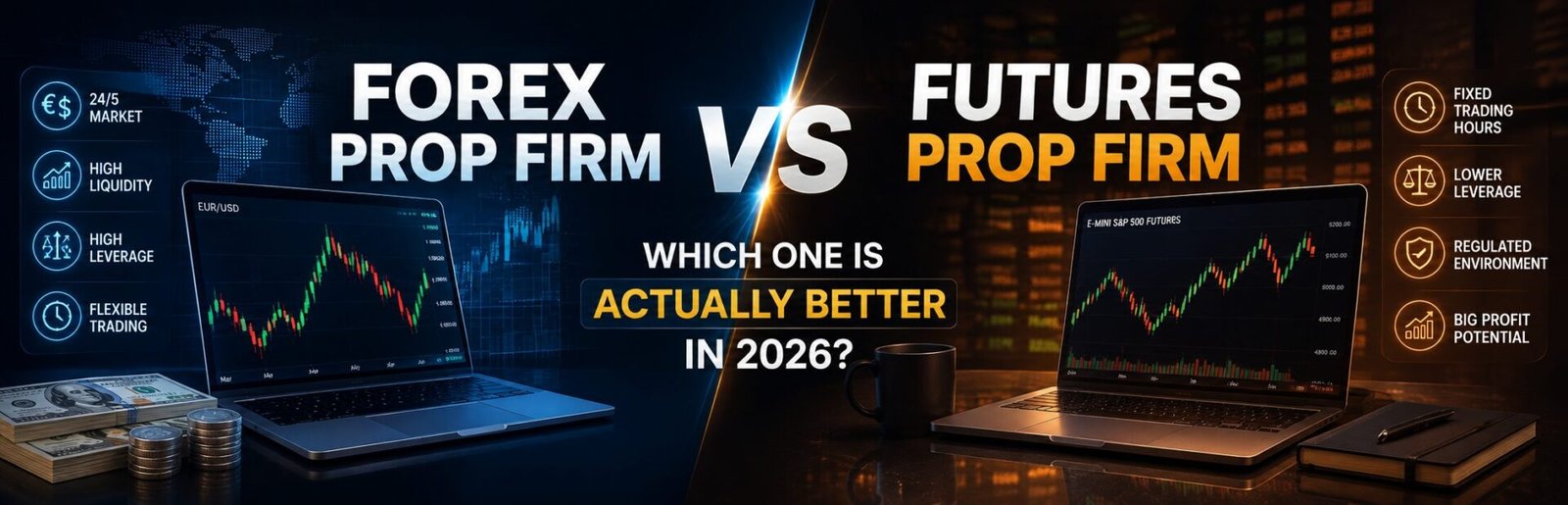
“Forex or futures?” is one of the most common questions from traders considering their first funded evaluation, and most content answering it defaults to a shallow comparison of profit splits and account sizes. That misses the actual decision.
Forex and futures prop firms aren’t just different products wearing different labels; they run on different market structures, different regulatory environments, and different risk mechanics, and those differences matter more for a beginner than any headline split percentage.
This guide breaks down a genuine prop firm comparison between the two models: how each one actually works, what it costs to get started, how the risk rules differ, and which type of trader tends to do better in each.
Whether you already lean toward one market or you’re genuinely undecided, understanding forex vs futures prop firms at the rule level, not just the marketing level, will save you from picking a path that fights against your natural trading style.
Plenty of traders eventually run accounts in both categories once they understand the mechanics well enough to know which instrument suits which part of their strategy. The goal here is to get you to that level of understanding faster than trial and error would, so your first evaluation fee, in either market, is spent on a firm and format that actually fit how you trade.
How Each Model Actually Works
- Forex Prop Firms
Give traders a simulated or internalized account funded against major, minor, and sometimes exotic currency pairs, typically alongside CFDs on indices, commodities, or crypto. Evaluations run on retail platforms like MetaTrader 4/5, cTrader, or DXtrade. The forex market is open nearly 24 hours a day across the trading week, which gives traders flexibility in session timing but also means volatility and liquidity vary sharply by time of day.
- Futures Prop Firms
Fund traders on real, exchange-listed futures contracts, most commonly CME products like E-mini S&P 500, Nasdaq, or crude oil futures. Evaluations typically run on platforms built for futures execution, such as NinjaTrader, Tradovate, Rithmic-based platforms, or TradingView integrations. Futures markets trade on defined exchange hours with scheduled settlement, and pricing is centralized through the exchange rather than routed through a broker’s own liquidity.
The core mechanical difference: forex prop trading generally happens on OTC (over-the-counter) style pricing controlled by the firm or its liquidity provider, while futures prop trading happens against an actual regulated exchange’s order book. That distinction shapes almost everything else in this comparison — cost structure, transparency, and even how disputes over fills get resolved.
Here’s a simple way to picture it. Imagine two beginners opening evaluation accounts on the same morning. The forex trader logs into MT5, pulls up EUR/USD, and sees a price quoted by their prop firm’s liquidity source; the exact tick they see may differ slightly from what a trader at a different broker sees at that same instant. The futures trader logs into a futures platform, pulls up the E-mini S&P 500 contract, and sees a single price shared by every participant trading that contract on the exchange, because it’s coming from one centralized order book rather than a network of individual liquidity providers. Neither price feed is “wrong”, they’re just structurally different, and that difference is the root of most of the practical distinctions covered below.
This also explains why the two industries evolved different cost models. Forex prop firms, dealing with OTC pricing and CFD-style instruments, can package an evaluation as a flat one-time fee because their exposure per trader is easier to model internally. Futures prop firms, working against real exchange contracts with exchange-set margin requirements, more often lean on recurring subscription pricing to cover the ongoing cost of data feeds and exchange-related overhead. Understanding this origin makes the cost comparison later in this guide much easier to reason about instead of just memorizing which model costs what.
Key Criteria for Beginners Choosing Between Them
- Cost Structure
Forex prop firms typically charge a one-time evaluation fee per attempt. Futures prop firms more often use a monthly subscription model that continues until you pass, reset, or cancel — meaning the total cost of a slow evaluation can climb higher than a one-time forex challenge fee if you take several months to pass.
- Market Hours and Lifestyle Fit
Forex markets run nearly around the clock on weekdays, which suits traders who can’t commit to a fixed session window. Futures markets follow the exchange’s trading hours, with defined open and close times (plus scheduled maintenance breaks), which can actually help beginners who benefit from a bounded trading day rather than an always-open market that tempts overtrading.
- Instrument Depth vs. Simplicity
Forex prop accounts often bundle in CFDs on stocks, indices, commodities, and crypto, giving you a wide sandbox to explore before settling on a specialization. Futures accounts are narrower by design — a handful of heavily traded contracts — which some beginners find easier to master because there’s less to spread attention across.
- Drawdown Mechanics
Both models use static, trailing, or hybrid drawdown rules, but the calculation basis differs. Futures prop firms commonly measure drawdown against your account’s closed-trade equity or end-of-day balance in ways that can be more forgiving of intraday drawdowns than tick-by-tick trailing models common in some forex evaluations — though this varies firm to firm, so check the specific rule sheet either way.
- Regulatory Backdrop
Futures contracts trade on regulated exchanges, and some futures prop firms emphasize this in their marketing, but the funded-account arrangement itself is still typically a simulated or performance-based structure, not a fully regulated brokerage relationship. The same caution about non-refundable evaluation fees and limited consumer protection applies to both forex and futures prop models.
Top Picks in 2026
Treat this as a starting shortlist for research, not a ranked endorsement — always confirm current fees and rules directly with each firm.
On the forex side:
- FTMO — operating since 2015 out of Prague, with cumulative payouts reported well over $500 million and a two-step evaluation (roughly 10%/5% profit targets) or a faster one-step alternative, both with no hard time limit. Splits start at 80% and scale to 90% via its Scaling Plan, tradable on MT4, MT5, cTrader, or DXtrade.
- FundedNext — headquartered in the UAE with a broad CFD lineup (forex, indices, commodities, stocks, crypto) plus a separate futures program. Multiple plan types (two-step Stellar, one-step Stellar, Stellar Lite, instant funding) each carry different drawdown percentages and a base 80% split that can be upgraded to 90–95% depending on the plan.
- The5ers — running since 2016 with a static, equity-based drawdown model and no hard time limit across its Hyper Growth, Pro Growth, and Bootcamp tracks, appealing to beginners who want to trade at their own pace without a countdown clock.
On the futures side:
- Topstep — one of the most established names specifically in futures-funded trading, with a long operating history and an evaluation model widely referenced as a benchmark by other futures prop firms.
- Apex Trader Funding — known for frequent promotional pricing on evaluations and a large lineup of account tiers, which has made it a popular starting point among cost-conscious beginners entering futures for the first time.
- Tradeify — a newer entrant with competitive account terms and a growing base of trader feedback; check current trader reviews and payout history before committing, since it has a shorter track record than Topstep.
As with the forex-side shortlist, treat account sizes, fees, and specific drawdown percentages as subject to change — futures prop firms in particular tend to update pricing and promotions often, so confirm current terms on each firm’s site before purchasing.
Comparison Table: Forex vs. Futures Prop Firms
| Factor | Forex Prop Firms | Futures Prop Firms |
| Underlying market | OTC currency pairs / CFDs | Exchange-listed futures contracts (e.g., CME) |
| Typical cost model | One-time evaluation fee | Monthly subscription until pass/reset |
| Market hours | Nearly 24/5 | Defined exchange hours with breaks |
| Common platforms | MT4, MT5, cTrader, DXtrade | NinjaTrader, Tradovate, Rithmic-based, TradingView |
| Instrument range | Often multi-asset (forex + CFDs) | Narrower, focused contract list |
| Pricing source | Firm/liquidity provider | Regulated exchange order book |
Pros and Cons of Each
Forex prop firms — Pros:
- Near-continuous market access fits varied schedules
- Often bundles multiple asset classes into one account
- One-time evaluation fee makes total cost predictable upfront
Forex prop firms — Cons:
- Pricing runs through the firm or its liquidity provider, not a public exchange
- Consistency rules and trailing drawdown models can be strict on some plans
- Regulatory oversight of the funded-account structure is limited in most jurisdictions
Futures prop firms — Pros:
- Trades against real, regulated exchange pricing
- Defined market hours can reduce the overtrading temptation for beginners
- Drawdown rules are often based on end-of-day or closed-trade equity, which can be more forgiving intraday
Futures prop firms — Cons:
- Monthly subscription costs can exceed a one-time forex fee if the evaluation takes several months
- A narrower instrument range means less room to diversify strategy within one account
- Contract specifications (tick value, margin) add a learning curve that beginners from a forex background may not expect
Risk Considerations
- The Total Cost of a Slow Pass Matters More in Futures
Futures evaluations often bill monthly, a beginner who takes four or five months to pass could end up paying meaningfully more than the advertised entry price suggests. Budget for this scenario, not just the best-case single-month pass. As a rough worked example: a futures evaluation advertised at a low monthly fee can look cheaper on paper than a forex challenge with a higher one-time price, but if it takes four months of subscription payments to pass, the running total can quietly overtake the forex option. Always multiply the monthly fee by a realistic pass timeline — not the fastest one shown in a firm’s marketing — before deciding which is actually the lower-cost path for you.
- Overnight and rollover rules differ by asset
Futures contracts have defined expiration and rollover dates that don’t exist in the same way for spot forex pairs; missing a rollover deadline can affect your position in ways a forex trader wouldn’t anticipate.
- Leverage and margin work differently
Futures margin is set by the exchange and clearing house and can shift during volatile periods, while forex leverage is typically set by the broker or prop firm itself. Confirm how each firm handles margin changes around high-volatility events like major economic data releases.
- Neither model is fully regulated as a retail investment product in most places
Whether you choose forex or futures, treat the evaluation fee as fully at risk, and verify what protections, if any, apply in your country before committing meaningful money across multiple attempts.
How to Get Funded in Each Model
For forex:
- Match your strategy to the specific drawdown model (static, EOD trailing, or intraday trailing) before buying.
- Confirm any consistency rules and track your daily P&L distribution during the evaluation.
- Verify news-trading and weekend-holding policies match how you actually trade.
For futures:
- Budget for the full subscription period a realistic (not best-case) pass timeline would require.
- Learn the specific contract’s tick value and margin requirements before risking a single trade in the evaluation.
- Confirm how the firm calculates drawdown — end-of-day balance versus real-time equity — since this changes how much intraday volatility you can absorb.
Step-by-Step Evaluation Checklist
Whichever path you’re leaning toward, work through this before paying for either type of evaluation:
- Decide whether near-24-hour access (forex) or defined exchange hours (futures) better fits your schedule and trading psychology.
- Calculate the realistic total cost of each option, including likely reset or resubscription costs if the first attempt doesn’t succeed.
- Confirm the exact drawdown calculation method and translate it into a real-currency number you can track daily.
- Check platform compatibility with any tools, indicators, or automation you already use.
- Review independent payout track records for your shortlisted firms in both categories.
- Demo-test your actual strategy against the specific rule set, not a generic version of it, before spending money.
- Read the fine print on rollover, overnight holding, and high-impact news restrictions for your chosen instrument.
Conclusion
There’s no universally “better” option in the forex vs futures prop firms debate; the right prop firm comparison depends on your schedule, your strategy’s structure, and how you handle cost predictability versus market transparency. Forex prop firms suit traders who want near-continuous market access, multi-asset flexibility, and a predictable one-time evaluation cost.
Futures prop firms suit traders who value regulated exchange pricing and defined trading hours, and are comfortable with a subscription model as long as they budget for a realistic pass timeline. Beginners often do better starting with whichever market they already understand at a basic level, rather than switching markets and firm rules at the same time.
Whichever you choose, the fundamentals from this guide carry over: check the drawdown model, understand the true total cost, and demo your strategy against the actual rules before you pay.
Final Checklist: Choosing Between Forex and Futures Prop Firms
- Market hours preference identified (near-24/5 vs. defined exchange hours)
- Realistic total cost calculated for each option, including likely resets
- The drawdown calculation method is understood and converted to real currency terms
- Platform and tool compatibility confirmed
- Independent payout track record reviewed for shortlisted firms
- Strategy demo-tested against the actual rule set before purchase
- Instrument-specific rules (rollover, news restrictions, margin) reviewed
Frequently Asked Questions
Not necessarily. Futures firms often advertise lower monthly fees, but because billing continues until you pass, reset, or cancel, a slow evaluation can end up costing more in total than a one-time forex challenge fee. Compare the realistic total cost, not just the advertised monthly price.
Neither is inherently better; it depends on your schedule and risk comfort. Forex suits traders who want flexible, near-24-hour access and multi-asset variety. Futures suit traders who prefer defined trading hours and pricing tied directly to a regulated exchange.
Yes, many traders start with whichever market they already know and expand later. Just be aware that the platforms, contract mechanics, and drawdown calculations differ enough that you should treat a switch as learning a new rule set from scratch, not just a new asset class.