


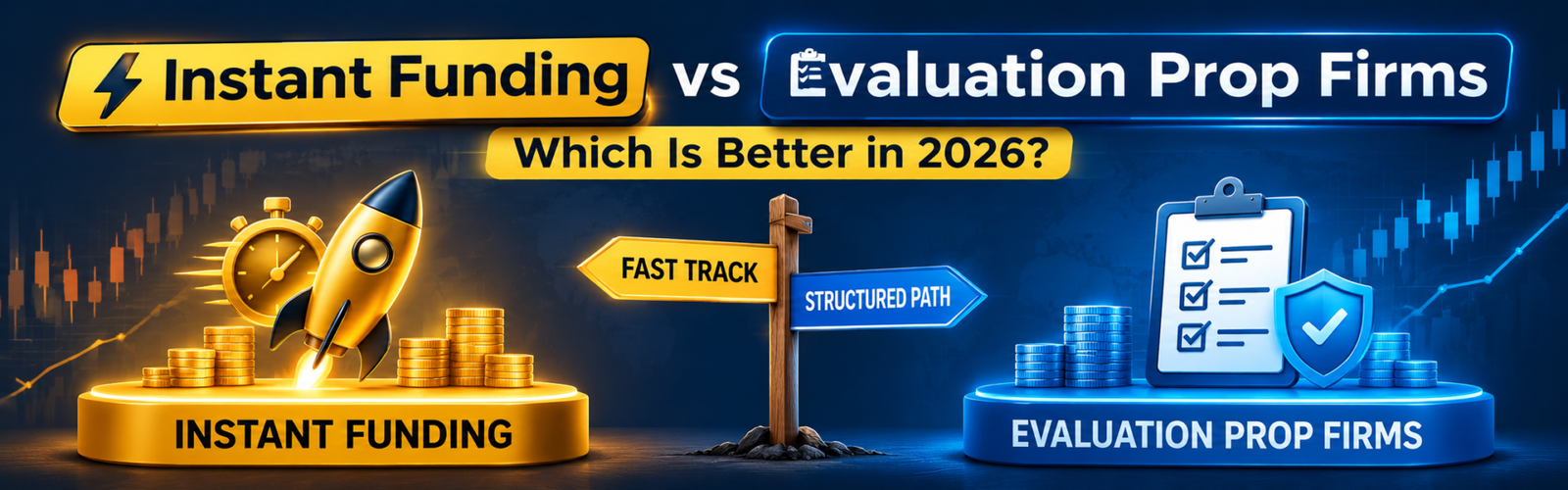
Most traders assume instant funding means getting paid faster. On the contrary, multiple 2026 industry analyses confirm that traders who must clear a profit buffer across minimum required trading days are frequently no closer to their first payout than someone who passed a standard two-step evaluation in week two.
The choice between these two prop firm models is one of the most consequential a retail trader can make, and the industry’s marketing rarely frames it accurately. One model is cheaper to fail. The other gets you active faster. Neither is universally better.
This guide covers how each model actually works, what it costs once you factor in drawdown rules and reset fees, and the specific trader profile where each path makes financial sense.
What Is an Evaluation Prop Firm Challenge and How Does It Work?
An evaluation prop firm challenge is a performance-based qualification process in which traders pay a one-time fee, hit defined profit targets while staying within drawdown limits, and earn a funded trading account upon passing. Profit targets typically range from 8% to 10% in Phase 1 and 4% to 5% in Phase 2, with the entry fee refunded by most established firms after the trader’s first successful payout.
One-Step vs. Two-Step Evaluation Formats
Most established firms offer at least one of two evaluation formats:
- Two-step challenges: The trader passes a primary phase requiring 8–10% profit, then a verification phase at 4–5%, before receiving a funded account. This model prioritizes confirmed consistency over speed and remains the standard at firms like FTMO.
- One-step challenges: A single phase requiring 8–10% profit with a faster path to funding. Several firms moved toward this structure in 2025 and 2026 as demand for shorter qualification timelines increased.
What You Must Achieve to Pass
Core requirements are consistent across established evaluation firms regardless of whether the program is one or two phases:
- A daily loss limit, typically 4–5% of the starting account balance
- A maximum total drawdown, usually 8–10% of the starting balance, measured from either the initial balance or the equity peak depending on the firm’s model
- A minimum number of trading days per phase, often 4–10, to prevent traders from passing on a single oversized position
- Consistency rules at many firms that cap how much of the total phase profit can come from any single trading day
Challenge fees range from approximately $150 to $500 for a $50K account. Most established firms refund this fee with the trader’s first funded-account withdrawal.
| Parameter | Typical Range (Evaluation Model) |
| Phase 1 profit target | 8–10% |
| Phase 2 profit target | 4–5% |
| Daily loss limit | 4–5% of starting balance |
| Maximum total drawdown | 8–10% |
| Entry fee ($50K account) | $150–$350 |
| Fee refund | Yes, with first payout |
| Starting profit split | 70–90% |
What Is Instant Funding and How Is It Different?
Instant funding is a prop firm model in which traders pay a higher one-time fee and receive immediate account access without completing any evaluation phase. There are no profit targets to meet before trading begins and no waiting period for credentials, but instant-funded accounts carry stricter risk parameters and significantly higher reset costs when accounts are blown.
How Instant Funding Actually Works
The mechanics are straightforward. You pay the fee, complete identity verification, and receive account credentials within hours. From that point, you trade under the firm’s risk rules on what is typically a simulated funded account with real profit payouts. Entry fees for instant funding on a $50K account typically run $400–$600 at list price, though active promotional discount codes can reduce this by 30–50% at many firms in 2026.
The Disguised Evaluation Problem: What to Watch For
Several firms market their products as instant funding while building a hidden qualification layer into the payout conditions. Account access is immediate; payout eligibility is not. Specific warning signs to verify before purchasing include:
- A minimum profit buffer the trader must reach before any withdrawal request is accepted
- A mandatory minimum number of calendar days on the funded account before the first payout is eligible
- A consistency rule capping the percentage of total profit allowed from any single trading day, requiring multiple profitable sessions before withdrawal eligibility unlocks
- A trailing drawdown that rises with your peak balance, creating a de facto qualification phase without labeling it as one
The accurate question to ask any instant funding firm is not “when can I start trading?” but “exactly what conditions must I meet before my first withdrawal, and what does that realistically take?”
For a detailed breakdown of how hidden payout conditions and fees compound across both models, read Forex Advocate’s guide to hidden fees in forex prop firms.
Evaluation vs. Instant Funding: A Direct Cost and Rules Comparison
The two models differ across every practical dimension a trader needs to assess before committing. The most overlooked difference is the cost of failure: a failed evaluation resets for a fraction of the original purchase price, while a blown instant funded account typically requires full repurchase at the original fee.
| Dimension | Evaluation Challenge | Instant Funding |
| Upfront cost ($50K account) | $150–$350 (typically refunded) | $400–$600+ (refund policy varies by firm) |
| Net cost if you pass | Often $0 after fee refund | $0–$600 depending on firm policy |
| Time to account access | 30–60 days after passing | Same day or within 24 hours |
| Time to first payout | 45–90 days total | 7–60 days depending on payout conditions |
| Daily loss limit | 4–5% of starting balance | 3–5% (often stricter) |
| Maximum drawdown | 8–10% | 5–10% (often stricter) |
| Drawdown model | Usually static or relative | Often trailing (more punitive) |
| Starting profit split | 70–90% (often starts at 80%) | 60–80% (often starts lower) |
| Cost of a blown account | Reset fee ($50–$150 typically) | Full repurchase ($400–$600+) |
The final row is where traders consistently underestimate total costs. A trader who blows three instant funded accounts during a difficult month spends $1,200–$1,800 before a single successful payout. The same trader burning through three evaluation attempts during the same period spends $450 or less in reset fees before eventually passing.
Does Instant Funding Actually Get You Paid Faster?
For most traders, no. The “funded today” marketing is accurate in one specific sense: account credentials arrive faster. Whether your first payout arrives faster depends entirely on the firm’s withdrawal conditions, which often include profit buffers, minimum trading day requirements, and consistency rules that can extend the timeline to first cash by several weeks.
The Time-to-First-Payout Reality
Evaluation firms require 45–90 days from the point of purchase to reach a first payout, including the challenge phases. Instant funding firms deliver account access the same day, but payout eligibility follows a separate schedule. Common instant funding payout conditions that extend the wait include:
- A mandatory profit cushion, often 5–10% of account balance, before the first withdrawal is approved
- A minimum number of calendar trading days on the funded account, typically 7–14 days at minimum
- A consistency requirement across multiple sessions before withdrawal eligibility is confirmed
A trader clearing a 5% buffer across seven mandatory trading days is not receiving payment faster than one who passed a single-phase evaluation in week two of their challenge.
Payout Buffers, Consistency Rules, and Hidden Delays
Industry analysis published in June 2026 by ThorTradeCopier (thortradecopier.com), an industry tracking site, draws the distinction directly: the “funded today” headline refers to account access, not cash in hand. Payout processing time once a request is approved typically runs 24–72 hours at established firms in 2026, and this applies equally to both models. The bottleneck is always the conditions a trader must satisfy before approval triggers, not the processing time itself.
Comparing prop firms across both funding models?
The Forex Advocate prop firms hub reviews both evaluation and instant-funded firms across 40+ criteria, including payout transparency, drawdown fairness, and trader-verified outcomes collected in 2026.
Which Funding Model Fits Your Experience Level?
The right model depends on your verified trading track record, your risk tolerance, and how much you can absorb in failed account costs. Traders without a consistent profit history are better served by evaluation challenges. Traders with documented strategies and tight drawdown control gain the most from instant funding, provided the firm’s drawdown rules fit their historical risk profile.
If You Are Building Consistency or Testing a New Approach
Evaluation challenges suit developing traders because:
- The lower entry cost means failed attempts are significantly cheaper to retry
- The structured phases create real accountability benchmarks against measurable targets
- Passing a multi-phase evaluation validates that your strategy holds under monitored conditions, not just in backtesting or favorable market periods
- You learn to operate within strict daily and maximum loss limits before larger capital is at stake
- A failed attempt costs a reset fee rather than a full repurchase, which reduces the financial pressure during a learning period
If you cannot describe your historical maximum drawdown from actual trade data, or if you have not traded consistently for more than three to six months, instant funding will cost more and teach less than evaluation would.
If You Have a Proven and Repeatable Edge
Instant funding becomes a rational choice when all of the following are true:
- You have a documented track record showing consistent profitability across at least six months of live or monitored sim trading
- Your strategy’s historical maximum drawdown sits comfortably inside the instant account’s drawdown limit with meaningful buffer remaining
- You have passed at least one evaluation challenge and understand how to operate under strict daily loss constraints
- Time is a genuine constraint: you need active funded capital this month rather than in 60–90 days
- You are running the instant account alongside other funded accounts rather than deploying your full trading budget into a single instant account
If your strategy’s maximum historical drawdown is 7% and the instant firm’s limit is 5%, no level of skill prevents an eventual account termination under normal market conditions.
How FTMO and FundedNext Structure Their Programs in 2026
FTMO and FundedNext are the most widely reviewed prop firms on ForexAdvocate, and both offer structured paths to funded trading with documented payout histories. FTMO operates primarily on an evaluation-based challenge model, requiring traders to meet profit targets before receiving a funded account. FundedNext has expanded its range to include both multi-phase evaluation programs and single-phase alternative structures, giving traders with different experience profiles a choice within the same firm.
| Firm | Primary Model | Profit Split | Account Sizes | Full Review |
| FTMO | Evaluation-based challenge | Up to 90% | $10K–$200K | Read FTMO review |
| FundedNext | Evaluation + single-phase options | Up to 90% | Multiple tiers | Read FundedNext review |
Both firms update their program structures periodically, and prop firm terms move fast enough in 2026 that any specific figure requires verification before you rely on it. For current fees, challenge rules, and payout terms confirmed this year, check the individual review pages linked above.
Six Questions to Ask Before Choosing a Prop Firm Funding Model
Before committing money to either model, these six questions will determine which path actually fits your situation. They draw on your trading history, your strategy’s risk profile, and your financial capacity to absorb failed accounts, so none of them have a universal correct answer.
- What is my verified maximum drawdown from actual trade data? If you cannot answer this from at least three months of real or monitored demo trading, you should not purchase instant funding.
- Does the firm use static or trailing drawdown? Static drawdown applies to your opening balance and does not move. Trailing drawdown rises with your equity peak, progressively shrinking your safety margin as you profit. Instant-funded accounts disproportionately use trailing drawdown.
- What are the exact payout conditions? Obtain the specific minimum profit percentage, minimum days on account, and consistency requirements before purchasing. Marketing copy is not a contract.
- What does a failed account cost to restart? For instant funding, this is the full purchase price. For an evaluation challenge, this is typically a reset fee, often a fraction of the original cost.
- What is my realistic timeline to first income? Calculate the actual time to first payout under each model’s conditions, including any profit buffer or minimum days, before concluding that instant funding is the faster option.
- Am I running this account alongside other funded accounts or alone? Using instant funding as one of several concurrent accounts changes the risk calculation substantially compared to deploying your full trading budget into a single instant account.
Which Model Should You Actually Choose in 2026?
Instant funding is the prop firm industry’s fastest-growing model across 2024 and 2026, confirmed by multiple industry tracking sources. The growth reflects how the model benefits firms as much as traders: faster upfront cash collection, no evaluation infrastructure required, and a strong appeal to traders who have failed challenge attempts on technicalities. That does not make it a poor choice. It makes it a specialized one.
Evaluation challenges carry a structural advantage for developing traders. The entry cost is lower, the cost of failure is lower, and the structured phases create real accountability that translates into better long-term discipline. For experienced traders with documented strategies whose drawdown profile fits comfortably inside instant account limits, instant funding removes a real friction by cutting weeks off the path to active capital. The choice between them is not about which model is better. It is about which model matches where you actually are as a trader, and that answer belongs to your trade history, not to the marketing on either model’s landing page.
Find the right prop firm for your funding model.
The Forex Advocate prop firms hub covers both evaluation and instant-funded programs across 40+ criteria, with 2026 data on payout transparency, rule fairness, and real trader feedback. Use the reviews to compare before you commit a dollar.
Frequently Asked Questions
Instant funding typically costs $200–$400 more per account for the same account size. A $50K evaluation challenge generally runs $150–$350, with the entry fee refunded after the first successful payout, making the net cost zero for traders who pass. A $50K instant funded account typically costs $400–$600, with fee refund policies varying significantly by firm and sometimes requiring multiple payouts before a refund is issued. The gap widens further when comparing the cost of failed accounts: a failed evaluation resets for $50–$150, while a blown instant account requires full repurchase at the original price.
Beginners can purchase instant funded accounts since no prior performance record is required for account access. Whether they should is a different question. Instant-funded accounts carry stricter drawdown limits with no evaluation buffer, meaning a trader still refining their approach will blow through accounts faster and at a higher cost per attempt than they would through evaluation resets. Traders who cannot describe their historical maximum drawdown from actual data are almost always better served by starting with an evaluation challenge, where failed attempts cost significantly less to retry.
A static drawdown limit applies to your initial account balance and does not change as your equity grows. If you start with $50,000 and the maximum drawdown is 10%, your account terminates if your balance falls below $45,000 regardless of any interim profits. A trailing drawdown rises with your equity peak. If you build the same $50,000 account to $55,000, your floor moves to $49,500. As you profit, your safety window shrinks. Trailing drawdown is more common in instant funded accounts and is significantly more punitive for strategies with normal equity fluctuation during winning periods, which is a rule difference most traders underestimate before signing up.
FTMO operates primarily through its evaluation-based challenge model, which requires traders to meet profit targets before receiving a funded account. FTMO has introduced alternative program structures over time, but its core offering and strongest track record remain on the evaluation side. For the current status of FTMO's available programs and whether instant-funded options are available as of 2026, see the Forex Advocate FTMO review, which we update to reflect changes in the firm's terms.
Check the payout conditions, not just the account access terms. True instant funding means no profit target must be met before the first withdrawal is approved. If the terms include a minimum profit buffer before first payout, a minimum number of required trading days, or a consistency ratio that must be satisfied before withdrawal eligibility, the firm is delivering instant account access, not instant access to payouts. Read the full terms before purchasing and look specifically for any condition attached to the first withdrawal, including minimum percentages, minimum days, and consistency requirements.